Showing posts with label Anita Silvey. Show all posts

Wednesday, July 18, 2012

From Anita Silvey's Children's Book-a-Day Almanac

 
Illustrated by Robert Lawson


On July 18, 1936, General Francisco Franco led an uprising of army troops in North Africa against the elected government of Spain. So began the Spanish Civil War, sometimes called “the first media war” because foreign correspondents and writers became involved—people like Ernest Hemingway and George Orwell. One would not expect this event to have much effect, at all, on American children’s books. By and large, children’s book publishing in the United States tends to be myopic, focusing inward rather than on world events.
However, timing is everything—in publishing, then and now. And the Spanish Civil War looms large as the defining publicity event for one of our classic picture books, The Story of Ferdinand. This seventy-page saga, illustrated with black-and-white drawings, began as something of a lark. Munro Leaf felt that bunnies and kittens had been done to death in picture books, and he wanted a more memorable protagonist—so he chose a bull. Robert Lawson, who also lived in New York City at the time, delighted in incorporating visual puns and references into his art. For this Depression Era book, their publisher Viking printed around 1,500 copies. But everyone involved in this creation had some pretty shocking surprises in store.
Because of the Spanish Civil War, people began to look for political messages in this story about a Spanish bull. Some thought it was Fascist, some Socialist, and some Communist. It was banned in Spain and in Germany as degenerate propaganda. But many opinion makers—including Franklin and Eleanor Roosevelt, Thomas Mann, H. G. Wells—rose to the book’s defense. When it comes to children’s books, any censorship attempt always sells a lot of books. As a society, we simply don’t want anyone telling us what our children should or should not read. The next year, eighty thousand copies were sold, and The Story of Ferdinand became a staple on the bestseller list.
Censorship can get books started, but not keep books going. What has sustained The Story of Ferdinand over the years is the wonderful interplay between the Leaf’s text and Robert Lawson’s art. The book does have a message—but not one about the Spanish Civil War. Pete Wentz of the rock group Fall Out Boys recently wrote about The Story of Ferdinand: “The book provides an amazing metaphor for how people can be. There’s something really honorable about following your own path and not doing what’s expected of you. When we recorded ‘From Under the Cork Tree,’ we experimented with different sounds. …When we are ninety years old and on our deathbeds, it will matter to us that at least we took chances and followed our own path.”
Seventy-five years after Munroe Leaf wrote The Story of Ferdinand, young readers still respond to its gentle humor, its advocacy of taking one’s own direction, and its happy ending. Just as Leaf and Lawson believed, the book tells the story of a bull that, in the end, was very happy.

Here’s a page from The Story of Ferdinand:
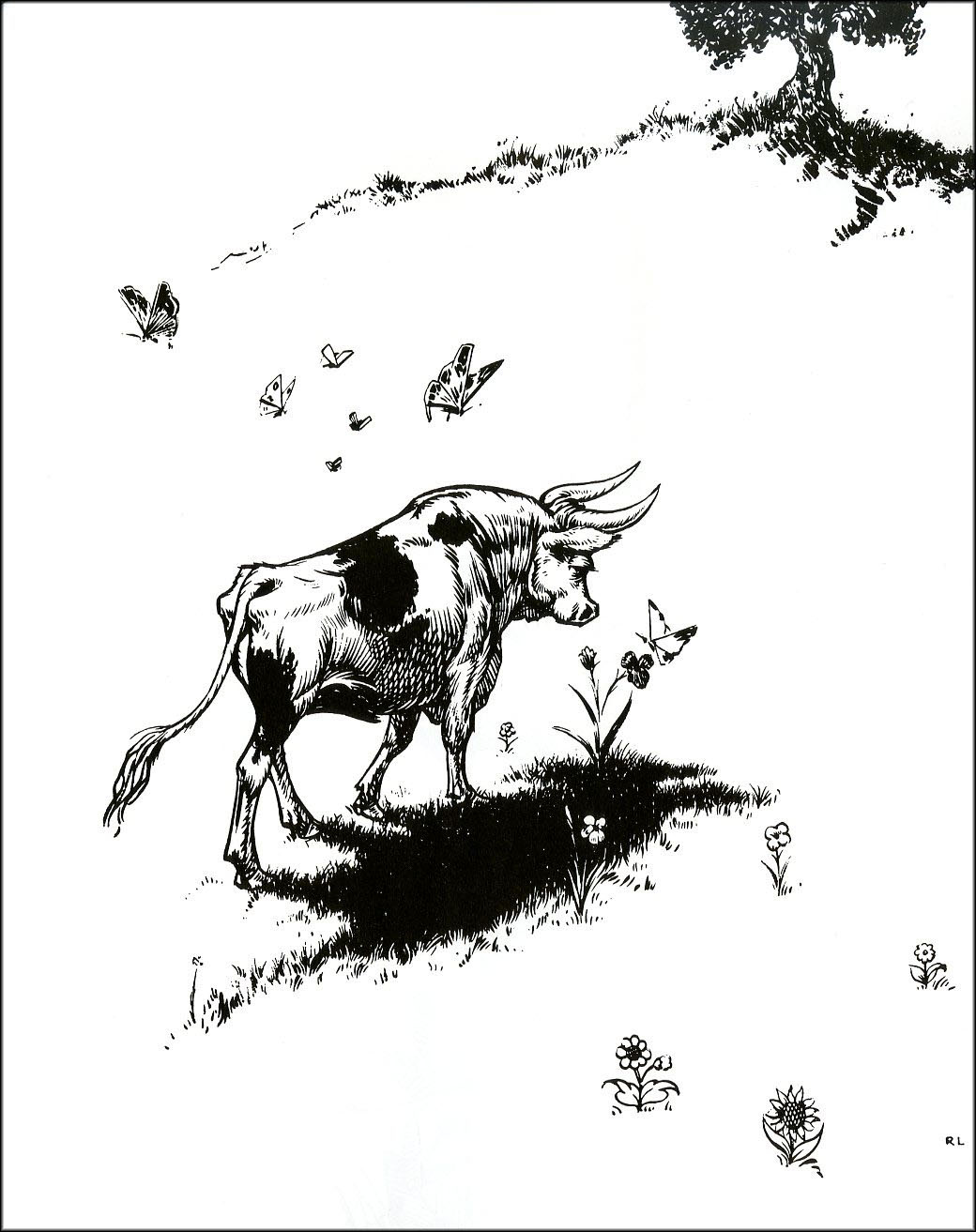


 All the other bulls ran around snorting and butting, leaping and jumping so the men would think that they were very very strong and fierce and pick them.
Ferdinand knew that they wouldn’t pick him and he didn’t care. So he went out to his favorite cork tree to sit down.
Originally posted July 18, 2011.
Tags: Animals, History

Tuesday, June 26, 2012

A Great Summer Classic from 1952


Robert McCloskey interviewed by Anita Silvey
http://archive.hbook.com/history/radio/mccloskey.asp


From Anita Silvey's Book-A-Day Almanac:

“I scream, you scream, we all scream, for ice cream,” goes the old ditty, and today marks National Chocolate Ice Cream Day. What a wonderful idea—two of the world’s most popular foods, chocolate and ice cream, celebrated together. For me, chocolate ice cream in June conjures up wonderful summer days, the ocean, sea gulls wailing, walks on the beach, clamming. In short, it brings to mind the plot of Robert McCloskey’s One Morning in Maine.
In the 1940s McCloskey married Margaret Durand, the daughter of storyteller and author Ruth Sawyer. In 1946 after their daughter Sally was born, the three of them moved from New York to an island on the Maine coast. Picture books of the modern era often lack a sense of place, but Robert McCloskey’s classic picture books of the late forties and early fifties are firmly grounded in details of the Maine coast and life in a small Maine community. These titles include two Caldecott Honor books, Blueberries for Sal (1948) and One Morning in Maine (1952), and the Caldecott Medal winner Time of Wonder, which made McCloskey the first artist to win the Medal twice.
In an interview, McCloskey once said that he always had one foot planted firmly midair—and the other on a banana peel. But rather than creating an absurdist or fantasy world as such a comment suggests, his Maine books are firmly grounded in reality. One Morning in Maine is the most personal picture book I know that has remained in print for almost sixty years. In it, Sal discovers that she has a loose tooth. She’s afraid she won’t be able to sail to Buck’s Harbor with her father as planned. But her mother talks to her and then sends Sal to help her father dig clams. Sal tells everyone she meets about her loose tooth—the fish hawk, the loon, and the seal. As she helps her father, she prattles on about her tooth, only to discover that it is missing and has fallen in the mud. They find a gull feather for her to make a wish on, and Robert, Sal, and baby sister Jane head out on the boat while their mother makes clam chowder. At the local store, Sal’s wish comes true—she gets a chocolate ice cream cone. And in the final line of the book the three head off for “CLAM CHOWDER FOR LUNCH!”
McCloskey renders this slice-of-life picture book so realistically that you can almost hear the gulls crying! Readers have been invited into a day of the McCloskey family’s life, one that is both special and very normal.
One Morning in Maine shows the details and beauty of the Maine coast, but it was also obviously created by a proud father. For many years now, the real Sal and Jane have been the guardians of their father’s work, protecting it from commercialization and exploit. I’ve always been grateful to them for their defense of these books, because the pressures on those who hold estate rights can be quite intense. Readers grew to love the children Sal and Jane in books. Now they have grown up to become women whom we can still admire. Let’s all raise an ice cream cone today—one chocolate and one vanilla—in their honor!


Tuesday, March 6, 2012

Anita Silvey on Dr. De Soto

Today we celebrate National Dentist Day. Suggestions for the day include delivering a thank-you note to your dentist—although I would recommend giving them the book of the day instead. For me, the greatest book ever written about a dentist is also one of the best picture books of the twentieth century: Doctor De Soto by William Steig.
In the stock market crash of 1929 Steig’s father lost everything, and, as a young man, Steig had to work to support his family. He could draw with great finesse and believed if he became a commercial artist he would have the best chance of putting food on the table. He sold his first cartoon to The New Yorker in 1930 and became their longest running contributor until his death in 2003, crafting scores of covers and more than seventeen hundred drawings.
Steig was a late bloomer when it came to children’s books and didn’t start publishing them until he was sixty. A fellow New Yorker artist, Robert Kraus, founded his own small publishing house, Windmill Books, and began enticing his friends to be authors and artists. With Windmill, Steig published Sylvester and the Magic Pebble, which won the Caldecott Medal in 1970. And with that he launched his next career, one that continued for thirty-five years.
In Doctor De Soto, William Steig explores what would happen if a mouse dentist suddenly had to deal with a fox as a patient. White-smocked and of good cheer, Doctor De Soto treats his larger patients, such as cows and donkeys, by climbing onto a ladder and using a hoist to get into their mouths. No one is more dedicated than the good doctor, although he does refuse cat patients, for obvious reasons. When a fox with a rotten bicuspid shows up, Doctor De Soto uses all his own cunning—and a little help from modern science. Readers watch with glee as the protagonist and his wife outwit a wily fox.
Steig’s art always looks fresh and vibrant, but that spontaneity actually took a great deal of work to achieve. Using Picasso as his model, Steig worked from a loose pen line and began his drawings with a face or an expression. If readers look closely at Steig drawings, they see the drooping mouths, raised chins, or narrowed eyes that reveal what the characters are thinking and feeling. Steig’s language matches his artwork to perfection. He always chose the right phrase. The text of Doctor De Soto, in fact, won a rare honor for a picture book, a Newbery Honor Award. His characters—Brave Irene, Shrek, Amos and Boris—enchant children. His language, humor, and playfulness make the books totally satisfying for all ages.
I am very grateful for dentists on this day that honors them. But I must admit, I would go a good deal more cheerfully to the dentist office if I thought I’d find Doctor De Soto there to greet me.
Here’s a page from Doctor De Soto:

Originally posted March 6, 2011. Updated for 2012.
Tags: Animals, Award Winning, Humor, Imagination, Mice, Newbery

Thursday, February 16, 2012

Smile by Raina Telgemeier

From Anita Silvey'sChildren's Book-A-Day Almanac:


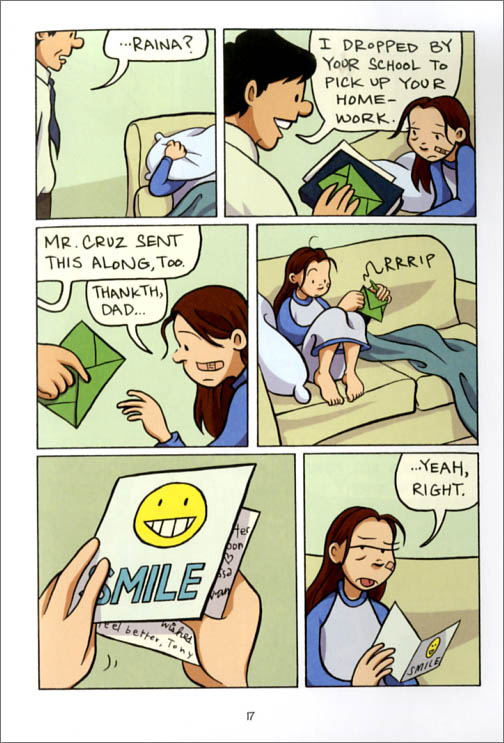
In this honest and straightforward book, examining the struggles of growing up and dealing with identify, Raina shares all her concerns—getting crushes, finding new friends, and slowly beginning to understand her place in a new school. In the end she finds the solution to her problems: “I threw my passion into things I enjoyed, rather than feeling sorry for myself. I realized that I had been letting the way I looked on the outside affect how I felt on the inside. But the more I focused on my interests, the more it brought out things I liked about myself.”
Few writers have given better advice to young readers. Because Raina uses the most popular format of the day, the graphic novel, to tell this story, she has already won over her audience by the time she delivers these lines. Readers come to love Raina, cheer her along, and even learn a great deal about what happens in the dentist chair and what various dental procedures entail. For anyone who has had to undergo extensive dental work, whether braces or reconstructive surgery, this book is almost a necessity.
Since publication, Smile has been wildly popular with young readers. John Schumacher, Librarian at the Brook Forest Elementary School in Oak Brook, Illinois, witnessed a fifth grader put the book in a friend’s hand, guide her to the circulation desk, and say, “You must check this out now and tell me your thoughts in the morning!” An interactive website has also been widely used by fifth and sixth graders. Some read Smile as a memoir; others simply find themselves fascinated by a story that rings so true to their own experiences. Outside of being easy to comprehend and a very fresh and honest look at common dilemmas among children and teens, Smile has been created by someone who remembers, in exacting detail, the concerns of fifth through eighth graders. In the end, whether you are an adult or child, after finishing this book you will find yourself smiling along with the protagonist.
Here’s a page from Smile:

Originally posted February 16, 2011. Updated for 2012.
Tags: Award Winning, Boston Globe-Horn Book Award, Family, Health, Humor, School
Share:

Thursday, November 17, 2011

Anita Silvey on The Snowman by Raymond Briggs

When this time of year comes around, I always think of one of my favorite books first published in 1978, which truly captures the joy of playing in the snow. Although comic-book format picture books and graphic novels rule today, when Raymond Briggs used the wordless, comic-book format in The Snowman, he broke with the tradition of his time. However, the result was so magical than even adults who might have shunned comic books found themselves in love with his story.
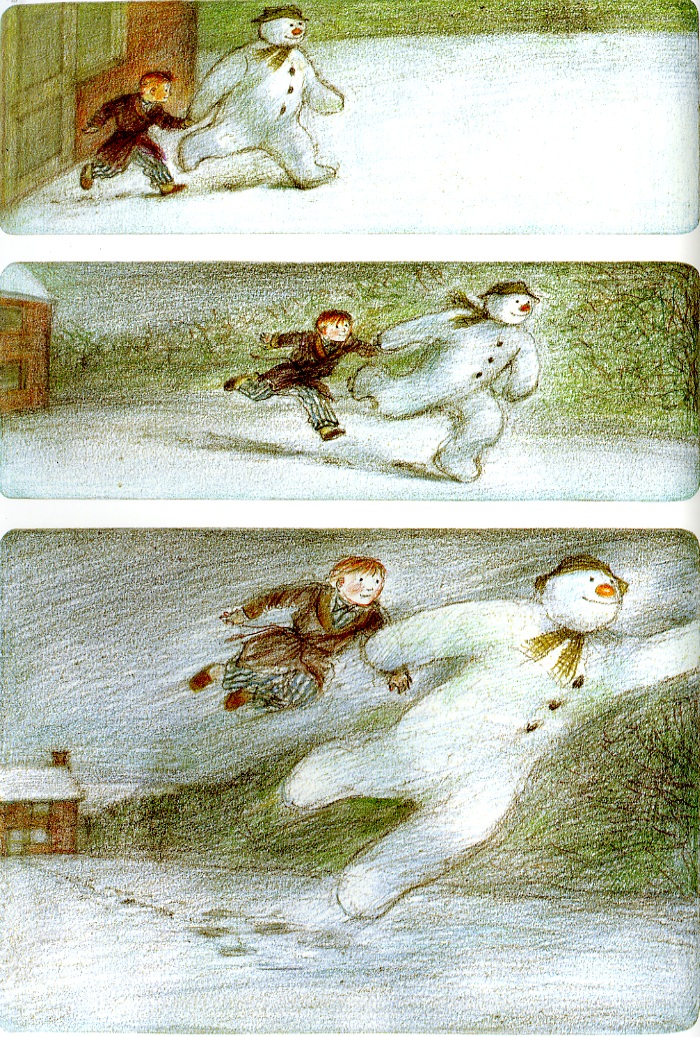
In a book that works for preschoolers and those up to ten, a little boy awakes to find a snow-filled landscape and then goes out to build a snowman. But when the boy checks on his creation that night, it has come alive and tips its hat to the boy. Then the snowman enters the house, plays with the boy, and shares a meal with him. Finally, the two set off together on a magical flight that takes them over land and sea. In the morning, the boy goes out to find a melted snowman, an ending tinged with melancholy and loss.
As a boy, Raymond Briggs had always wanted to be a cartoonist. At fifteen, to pursue this dream, he became a student at the Wimbledon School of Art in London. Like other art students of the era, he received training in classical nineteenth-century composition, still-life and figure drawing. Eventually, he decided that he did not want to become a painter. However, when he finally returned to his childhood dream of making a comic book, he was able to bring all of his skills in draftsmanship, composition, and anatomy to The Snowman.
Although the landscape seems exotic, Briggs used his own home and garden in Sussex, at the foot of the South Downs, a few miles from Brighton. The snowman flies over the Downs to Brighton, and then the Royal Palace. Since Briggs wanted a feeling of childlike spontaneity in the drawings, he worked in pencil crayons to prepare the art. This media created a book with soft color, almost as if every page has been muted by the fallen snow.
The Snowman draws on the power of a persistent childhood fantasy—what if the snowman a child is building could come alive. This completely satisfying and moving book was adapted quite successfully as an animated film often shown on television during the holidays. As I checked this book out of the library recently, one young woman ran over and exclaimed, “I loved that book when I was a child!” Children still do. In The Snowman Raymond Briggs demonstrated how art alone, without any text, can convey a story that children delight in and remember.
Here’s a page from The Snowman:

Originally posted December 23, 2010.

Friday, August 19, 2011

Anita Silvey talks about Wemberly Worried!


For some children, the end of August means preparing to go to school for the very first time. For them August has been designated Get Ready for Kindergarten Month. If you are hunting for a book that might help the very young overcome some of their anxieties about school, today we’ll look at Kevin Henkes’s Wemberly Worried and tomorrow, Antoinette Portis’s Kindergarten Diary.
First published in 2000, Wemberly Worried appears to be one of the many Kevin Henkes titles headed for classic status. As a young artist, Kevin got a head start on creating books for children. He always knew he wanted to write and illustrate books, and he got his foot in the door of a publisher when he was nineteen. Since then, he has crafted one fabulous book after another.
Although Kevin is now married with children of his own, he is one of those gifted creators who has never forgotten what it feels like to be small and young and vulnerable. His books always have a truth to the way children think and feel.
In our book of the day, Kevin opens the story with these words: “Wemberly worried about everything.” And readers get to see all the things that concern our mouse heroine—such as shrinking in the bathtub. Although everyone in her family tries to tell her not to worry—including her pretty hip grandma mouse sporting a “Go with the Flow” T-shirt—Wemberly just can’t help the thoughts that go through her mind. The radiator might contain a snake; a tree might fall on their house. So when school looms, she worries about the beginning of school. On a two-page spread her worries are even listed in large type: a mean teacher, a smelly room, finding the bathroom.
But of course, in Kevin Henkes’s universe, everything turns out for the best. Wemberly finds a friend and discovers that her teacher, Mrs. Peachum, may not be so bad. By the end of the first day, she jauntily walks out of the room, telling everyone she’ll return. “I will,” she says. “Don’t worry.”
By creating a character full of neuroses, Kevin Henkes allows children to laugh at their own fears and feel that, in the end, going to school might just not be so bad after all.
So to relieve your children’s anxiety—and your own—about the beginning of a new school year, pick up Wemberly Worried. I should probably read it to my graduate students on the first day of class—it applies equally to them.
Here’s a page from Wemberly Worried:


Tuesday, August 2, 2011

Anita Silvey's Book-a-Day Almanac

Daily children’s book recommendations and events from Anita Silvey.
Discover the stories behind the children’s book classics . . .
The new books on their way to becoming classics . . .
And events from the world of children’s books—and the world at large.


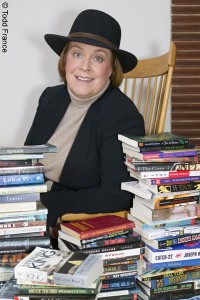
Anita Silvey has been the editor of The Horn Book review journal and the publisher of children’s books at Houghton Mifflin. She estimates that she’s read about 125,000 kids books over the past 40 years. When she’s not reading, she teaches courses in children’s literature, writes nonfiction, and travels all over the country talking to parents, teachers, and librarians about the best books for kids. Visit her at anitasilvey.com.