Showing posts with label wordless. Show all posts

Thursday, April 19, 2012

The Hero of Little Street

 
Kirkus Reviews


THE HERO OF LITTLE STREET (reviewed on January 15, 2012)
Rogers' Boy (from The Boy, the Bear, the Baron, the Bard, 2004, and A Midsummer Knight, 2007) returns for another wordless metafictive adventure, this one centering on Dutch painting.
The action starts in modern-day Trafalgar Square, where the Boy dumps three other boys' soccer ball into a fountain and then flees to the National Gallery. After some aimless wandering, he's only a little astonished to find the scruffy little dog from van Eyck's Arnolfini Portrait jumping out of the frame to play. The dog leads the Boy into Vermeer's Young Woman Seated at a Virginal and then into the titular Little Street of 17th-century Delft, Holland. Since young readers are probably even less likely to groove on Vermeer than on Shakespeare, who figured in the earlier titles, the romp must depend upon plenty of slapstick to keep them engaged—and it delivers. Small, comic-book–style panels convey the action, punctuated by breathtaking longshots of galleries and the streets and canals of Delft. Boy and dog career along, tripping up pedestrians and smashing blue-and-white crockery before running afoul of a sinister butcher (who resembles a certain Bard). There's nothing stuffy about this, despite its high-toned beginning: Rogers simply uses his own love of the art as a springboard for his endearing brand of foolery.
All's well that ends well, as this frolic does, with a sublime comeuppance for all the bullies, then and now. (Picture book. 4-8)

Pub Date: March 27th, 2012
ISBN: 978-1-59643-729-6
Page count: 32pp
 

Sunday, February 5, 2012

Few words on five wordless books

Because the creators of wordless books can say so much with no words at all, I decided to use sparse words to express my awe for each of these titles and let their gorgeous covers invite you in.

#1 Sea of Dreams by Dennis Nolan

Adventure over and under the sea . . .


#2 The Conductor by Laetitia Devarney
Swirl, whirl, leaves take flight . . .


#3 Where’s Walrus by Stephen Savage

Where is that wacky walrus?
 #4Tuesday by David Wiesner


And what if frogs floated by?

#5 Beaver is Lost by Elisha Cooper
Beaver travels to a bustling city and back.

Thanks to Adopt a School Funds which purchased #1 and #2 for our classroom wordless (or nearly) collection. Wordless books allow us to practice using picture clues and background knowledge to infer meaning. They are also lovely to share together or to ponder over alone.

Monday, December 19, 2011

More on The Snowman by Raymond Briggs

http://www.thesnowman.co.uk/

About The Snowman:

One winter morning a little boy named James wakes up to find that everything outside has turned snow-white. Overjoyed, James rushes downstairs and into the garden, where he begins to build a snowman. James sleeps fitfully, and at midnight he wakes up and decides to check on his snowman. He opens the back door... he can't believe his eyes... The snowman has come to life! James finds himself face to face with a smiling snowman, who with a polite doff of his hat introduces himself and marks the beginning of magical friendship and marvellous adventure

About Raymond Briggs:

Born in 1934 in London, Raymond left school at fifteen to study painting at the Wimbledon School of Art. He then studied typography at the Central School of Art and subsequently went on to study painting at the Slade School. When he graduated in 1957, he immediately started writing and illustrating, and in 1961 also began work as a part-time lecturer in illustration at Brighton Polytechnic. After a brief spell in advertising he then fully concentrated on writing and illustrating children's books. His first full-colour book of rhymes, Ring-A-Ring O'Roses, was published in 1962. Followed by Fee Fi Fo Fum (1964), The Mother Goose Treasury (1966), Jim and The Beanstalk (1970) and The Fairy Tale Treasury (1972). Evident from all these early books Raymond both writes and illustrates, he himself once said "the whole point of illustration is that it is literary. If it is not, it remains a drawing only". But it was in 1973, with the publication of Father Christmas that Raymond Briggs' unique and distinctive 'comic strip' style became established. Father Christmas was portrayed as a rather grumpy, discontented, and above all 'human' figure. However, it was very successful, and so was followed Father Christmas Goes on Holiday (1975). Raymond's other work includes Fungus The Bogeyman (1977), Gentleman Jim (1980) and the more adult, satire of nuclear war When The Wind Blows (1982). Raymond won the Francis Williams Award for Best Children's Book in 1982 with The Snowman. The Snowman written in 1982 has become a year-round favourite and one of the most popular Yuletide books ever published.Raymond is still writing prolifically, so keep an eye out for his latest releases.


Did you know that there is a stage show of The Snowman?  For video clips and information, go to http://www.birmingham-rep.co.uk/about/snowman-home/

Thursday, November 17, 2011

Anita Silvey on The Snowman by Raymond Briggs

When this time of year comes around, I always think of one of my favorite books first published in 1978, which truly captures the joy of playing in the snow. Although comic-book format picture books and graphic novels rule today, when Raymond Briggs used the wordless, comic-book format in The Snowman, he broke with the tradition of his time. However, the result was so magical than even adults who might have shunned comic books found themselves in love with his story.
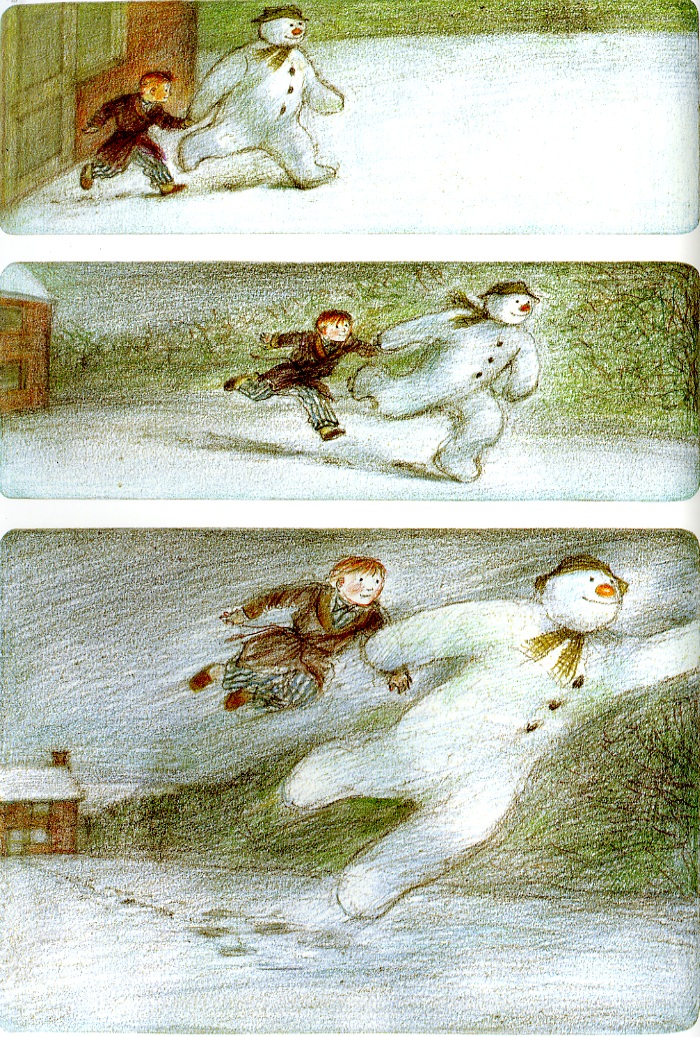
In a book that works for preschoolers and those up to ten, a little boy awakes to find a snow-filled landscape and then goes out to build a snowman. But when the boy checks on his creation that night, it has come alive and tips its hat to the boy. Then the snowman enters the house, plays with the boy, and shares a meal with him. Finally, the two set off together on a magical flight that takes them over land and sea. In the morning, the boy goes out to find a melted snowman, an ending tinged with melancholy and loss.
As a boy, Raymond Briggs had always wanted to be a cartoonist. At fifteen, to pursue this dream, he became a student at the Wimbledon School of Art in London. Like other art students of the era, he received training in classical nineteenth-century composition, still-life and figure drawing. Eventually, he decided that he did not want to become a painter. However, when he finally returned to his childhood dream of making a comic book, he was able to bring all of his skills in draftsmanship, composition, and anatomy to The Snowman.
Although the landscape seems exotic, Briggs used his own home and garden in Sussex, at the foot of the South Downs, a few miles from Brighton. The snowman flies over the Downs to Brighton, and then the Royal Palace. Since Briggs wanted a feeling of childlike spontaneity in the drawings, he worked in pencil crayons to prepare the art. This media created a book with soft color, almost as if every page has been muted by the fallen snow.
The Snowman draws on the power of a persistent childhood fantasy—what if the snowman a child is building could come alive. This completely satisfying and moving book was adapted quite successfully as an animated film often shown on television during the holidays. As I checked this book out of the library recently, one young woman ran over and exclaimed, “I loved that book when I was a child!” Children still do. In The Snowman Raymond Briggs demonstrated how art alone, without any text, can convey a story that children delight in and remember.
Here’s a page from The Snowman:

Originally posted December 23, 2010.