By Lisa Guernsey
Video, TV, interactive books, screen-based games: Young children
today are practically bathed in this stuff as young as toddlerhood. What
is the impact? As a parent who is simultaneously fascinated by and
worried about the impact of electronic media on my children─and as a
journalist and researcher specializing in education, technology, and
social science─I have been digging for answers. Along the way I’ve come
upon several research findings that overturn conventional wisdom. Here
are five common parental assumptions that the research does not
necessarily support.
Assumption 1: As long as the content is “educational,” it’s good for children.
What the research shows: Children don’t always learn what the program
creators intend; sometimes they actually learn the opposite.
When I started the research for
Screen Time, I expected to
find what many of us have been brought up to believe: As long as a
program is teaching the children something, as long as it seems to send
positive messages, as long as it is produced by an educational station I
trust—everything is fine. But I wasn’t prepared for the wide variation
among programs that label themselves as “educational.” Many parents
wrongly assume that their children will automatically understand what is
happening on screen. But the way information is presented can support
or get in the way of a child’s ability to comprehend. Simply having
characters utter nice new words, for example, doesn’t mean that toddlers
or preschoolers will learn what those words mean. A show that has
characters pointing to and labeling objects can be a big help, but a
show designed by people without a clue about the language development
under way among its audience (in my book and presentations I pick on
Veggie Tales and
Bob the Builder) may not be building language skills at all.
One eye-opening study focused on the program
Clifford the Big Red Dog.
Researchers (Mares & Acosta 2008) asked whether kindergartners were
grasping messages of tolerance and kindness in an episode about a
three-legged dog. Although the point of the story was to show that
friendship overcomes physical differences, the University of Wisconsin
researchers found that children were likely to be more intolerant after
watching the show. How could that be? The researchers theorize that the
story’s delivery backfired. Because the bulk of the episode was focused
on the dog’s physical differences (with only a few minutes at the end
dedicated to all the characters joining happily together), children may
have been too preoccupied with the dog’s three-leggedness to catch the
moral lesson. The designers of the show didn’t seem to recognize how
kindergarteners interpret, recall, and learn from what they see.
Assumption 2: The TV may be on in the background, but my children aren’t affected.
What the research shows: The TV shows in the background may be impacting your child more than you think.
Nearly 40 percent of families with children up to 4 years old have
the television on most or all of the time (Rideout, Hamel, & the
Kaiser Family Foundation 2006). When my daughter was 1, I remember
thinking that it didn’t matter whether the television was on or not.
Look, I would tell myself proudly, she barely notices. She’s not lured
in the least. But once I delved into the research, I learned that even
if young children don’t seem to be paying attention to it, background
television can have a more negative influence than one might think.
Some of the most potent research on background TV comes from a series
of experiments in a lab at the University of Massachusetts at Amherst
(Schmidt et al. 2008). The lab was set up to look like a living room,
with toys, a TV, a couch, a coffee table, and some magazines. Mothers
brought their 1-, 2- and 3-year-old children to that room, where for 30
minutes of their visit the TV was on. For another 30 minutes, it was
off. Careful observation of the children in these experiments showed a
significant difference between the way children played with their toys
in each condition. When the TV was on, children bopped from toy to toy,
spending significantly less time with one toy than when the TV was off.
Even when they weren’t looking at the TV, and most children in this
study weren’t, it seemed as if something was distracting them. The
background TV, whether it was the noise or the flash of images, was
interfering with their play.
University of Massachusetts researchers also looked at how parents’
interactions with their children differed under TV-on and TV-off
conditions. They found that when the TV was on, there was a 21 percent
decrease in the amount of time that parents spent interacting with their
children. And the quality of those interactions (as measured by how
actively they played together) decreased too (Kirkorian et al. 2009).
Assumption 3: All media for children under age 2 is damaging.
What the research shows: If parents use media with children under 2,
they should make sure that screen time leads to social interactions with
their babies and toddlers, instead of replacing those interactions.
Parents should avoid exposing their very young children to
adult-directed programming.
In 2011 the American Academy of Pediatrics reiterated its
recommendation discouraging parents from using media with children under
24 months of age. The AAP’s statement cited three reasons: a lack of
evidence on children learning from television or video before age 2; a
few studies showing a link between the amount of TV that toddlers watch
and later attention problems; and some studies pointing to how parents
and playtime are affected by always-on TV. From a “do no harm”
perspective, AAP’s reliance on this research makes sense, and much of it
is based on respectable peer-reviewed work in medicine and health.
But the fact is that many children under 2 do use screen media, so
some researchers point to the value of paying attention to how those
families select and use that media. Researchers are coming to agree:
How parents approach media matters. For example, Alan Mendelsohn, a
pediatrician and researcher at New York University, has shown that
negative impacts typically associated with television watching can be
lessened when parents talk to their babies about what they are seeing on
screen (Mendelsohn 2010).
Another way of looking at young children and screens is to explore
whether a child might learn from watching or playing with what is on
screen. A growing number of studies show that what is on the TV or
tablet (the content) can make a big difference. For example, when
researchers followed up on their study that originally showed links
between television viewing and attention problems, they determined that
the
content of the programs mattered. When they looked at
children under 36 months old who had watched “educational” programming
(defined in part by programs that contained no violence), the link to
attention problems disappeared (Zimmerman & Christakis 2007).
Also important is how parents manage media use in daily routines and
interact with their children before, during, and after they watch and
play (the context). The needs of the child have some bearing here too.
Even at the same age, children can be very different developmentally. A
verbally precocious 21-month-old may be able to learn some words
directly from a video while another 21-month-old may not, as was shown
in a 2005 study on
Teletubbies (Grela, Krcmar & Lin 2004).
That study, it should be noted, was conducted in a laboratory and
designed to look specifically at whether babies could pick up the
meaning of a word when it was connected to a particular object labeled
by speakers on screen. As shown in other studies, the way words are used
in children’s programming is an important factor in determining whether
children will learn them. And a vast collection of findings from other
studies makes clear that learning language (not just learning words) is
dependent on social interactions between people.
By synthesizing the studies on children’s health, learning, and media
interactions, I’ve concluded that we as parents could do the most good
for our children by focusing on the three C’s—content, context, and the
individual child.
Assumption 4: Scary movies and TV shows just go over children’s heads.
What the research shows: Scary programs influence children’s sleep and more.
In my interviews and conversations with parents, I have come across a
fair proportion who don’t worry about showing their preschoolers movies
or TV shows that were made for older children and adults. Their
children, they say, don’t seem to be bothered by moments of aggression
or distressing scenes. And surely they are too young to really
understand what they are seeing anyway.
But research on the content of TV and video programs watched by young
children suggests that parents may want to pay more attention to what
appears on their TV set or tablet after all. A growing number of studies
are finding links between children’s cognitive development and
“adult-directed television” (think
C.S.I., the evening news, or
even PG-rated movies that have scary scenes). A study at Georgetown
University, for example, gathered data on family media habits and
tracked children’s growth over several years (Barr et al. 2010). It
found that children who performed poorly on cognitive tests at age 4
were the same children who were put in front of adult-directed TV when
they were 1 year old. Poor scores also were linked to the watching of
these programs at age 4. One theory is that when watching adult-directed
TV, children’s minds are in fact quite busy trying to figure out what
is going on, but the scenes and characters are appearing faster than
they can fully understand and mentally process given how little
background knowledge they have to draw upon.
Research (Garrison & Christakis 2012) reported in the August 2012 issue of
Pediatrics
highlights another reason to pay attention to content: sleep schedules.
Anyone with a young child understands how critical sleep can
be—especially for parental sanity—so it’s worth examining whether
exposure to violent content could interfere with bedtime and naptime.
Using data from a randomized controlled trial with 565 families in
Seattle, researchers Michelle Garrison and Dimitri Christakis at the
University of Washington examined the impact of a parent-support program
intended to help moms and dads choose age-appropriate and nonviolent
media for their 3- to 5-year-olds.
The program worked. Sleep problems declined for children of parents
assigned to receive the support (coaching and educational materials)
compared to those who didn’t. And the support was most effective for
families that initially reported watching higher levels of violent media
than other participating families. In other words, the mechanism for
reducing sleep problems was the reduction in exposure to violent TV.
Assumption 5: E-books are distracting to young children.
What the research shows: It’s all about how they are used.
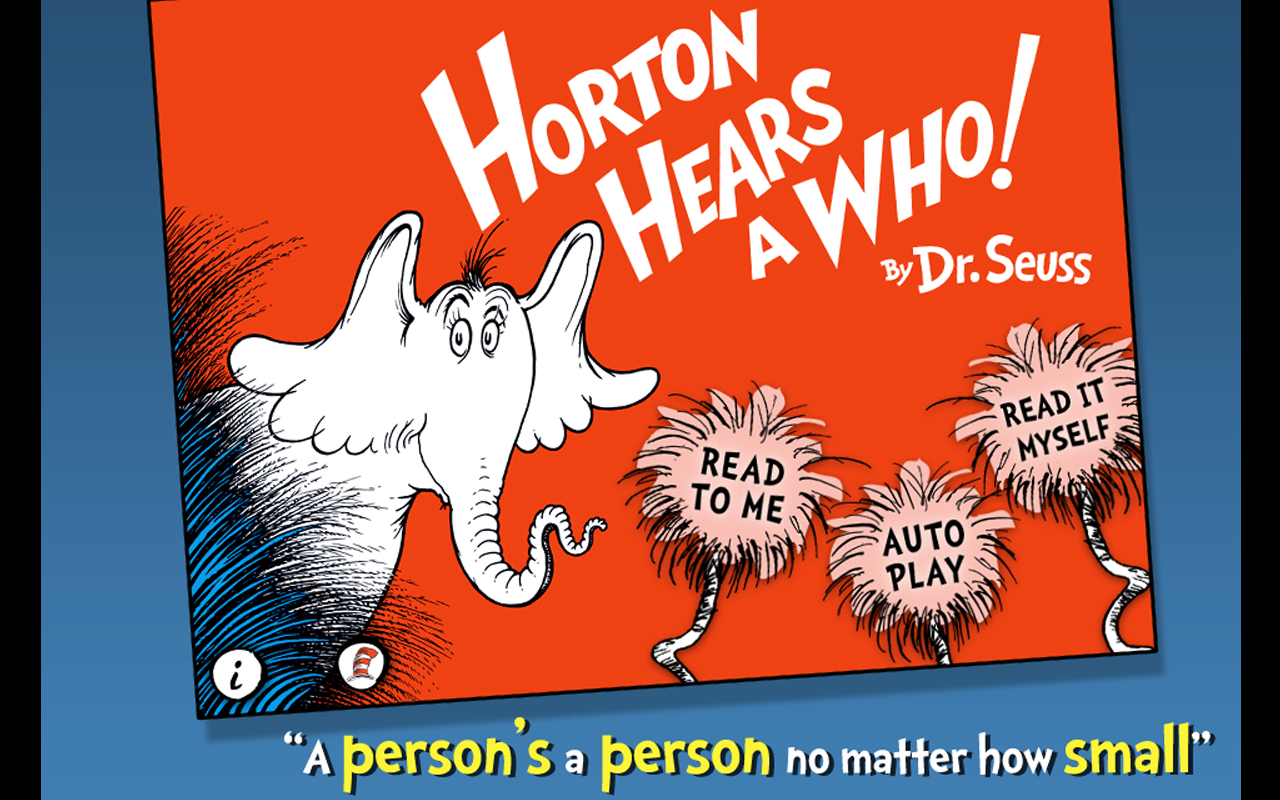
It’s true that many e-books for children come with so many bells and
whistles that children merely click around on the screen without paying
much attention to the storyline. It’s also true that some research has
uncovered parents’ tendencies to focus on the technology (telling their
kids when and where to click) and not the story when reading an e-book
with their children. This is leading children to recall very little
about what was read. In a small study conducted at Temple University,
for example, “behavioral directives went through the roof” while reading
comprehension sunk (Parish-Morris, Collins, & Hirsh-Pasek 2006).
But after reading these studies carefully, it becomes clear that at
least two factors are at play: the design of the e-books and the
behavior of the parents. Tackle these issues, and electronic books could
be no different or better than printed books. Some e-book companies,
for example, are designing picture e-books to favor highlighted text and
engaging storylines over distracting playthings. As e-books become less
of a novelty, parents may also become less inclined to order their
children around on how to use them. A more positive approach to e-books,
however, will require parents and educators to stress the importance of
content, context, and the individual
child (the Three C’s) in choosing media for our children.
Note: Technology changes quickly. Use the research-based
NAEYC/Fred Rogers Center position statement on “Technology and
Interactive Media in Early Childhood Programs Serving Children from
Birth through Age 8” for guidance on when and how to use technology with
young children in ways that will help, not harm.
www.naeyc.org/content/technology-and-young-children
References
Barr, R., A. Lauricella, E. Zack, & S. Calvert. 2010. Infant and
Early Childhood Exposure to Adult-Directed and Child-Directed
Television Programming: Relations with Cognitive Skills at Age Four.
Merrill-Palmer Quarterly 56 (1): 20-48.
Council on Communication and Media. 2011. Media Use by Children Younger Than 2 Years. Policy statement.
Pediatrics 128 (5).
http://pediatrics.aappublications.org/content/early/2011/10/12/peds.2011-1753.full.pdf+html
Garrison, M., & D. Christakis. 2012. The Impact of a Healthy Media Use Intervention on Sleep in Preschool Children.
Pediatrics 130 (3): 492-99.
http://pediatrics.aappublications.org/content/130/3/492.full.pdf+html
Grela, B.G., M. Krcmar, & Y.J. Lin. 2004, May 18. Can Television Help Toddlers Acquire New Words?
www.speechpathology.com/articles/arc_disp.asp?article_id=72&catid=491
Kirkorian, H.L., T.A. Pempek, L.A., Murphy, M.E., Schmidt, & D.R.
Anderson. 2009. The Impact of Background Television on Parent-Child
Interaction.
Child Development 80 (5): 1350-59.
Mares, M.L., & E. Acosta. 2008. Be Kind to Three-legged Dogs: Children’s Literal Interpretations of TV’s Moral Lessons.
Media Psychology 11 (3): 377-99.
http://commarts.wisc.edu/mares/three-legged-dogs.pdf
Mendelsohn, A.L., C.A. Brockmeyer, B.P. Dreyer, A.H. Fierman, S.
Berkule-Silberman, & S. Tomopoulos. 2010. Do Verbal Interactions
with Infants during Electronic Media Exposure Mitigate Adverse Impacts
on Their Language Development as Toddlers?
Infant and Child Development 19: 577-93.
Parish-Morris, J., M.F. Collins, & K. Hirsh-Pasek. 2006.
Electronic Books: Boon or Bust for Interactive Reading? Paper presented
at Boston University Conference on Language Development, November 3.
Rideout, V., E. Hamel, & the Kaiser Family Foundation. 2006.
The Media Family: Electronic Media in the Lives of Infants, Toddlers, Preschoolers, and Their Parents. Menlo Park, CA: Kaiser Family Foundation.
www.kff.org/entmedia/upload/7500.pdf
Schmidt, M.E., T.A. Pempek, H.L. Kirkorian, A.F. Lund, & D.R.
Anderson, 2008. The Effects of Background Television on the Toy Play
Behavior of Very Young Children.
Child Development 79 (4): 1137-1151.
Zimmerman, F.J., & D.A. Christakis. 2007. Associations Between
Content Types of Early Media Exposure and Subsequent Attentional
Problems.
Pediatrics 120 (5): 986-92.
Lisa Guernsey is the author of
Screen Time: How Electronic Media—from Baby Videos to Educational Software—
Affects Your Young Child (Basic Books, 2012).


 Toca Train