Monday, December 19, 2011

Because even dogs send Christmas cards...


Happy Holidays from Mariah (above) and Jacoby (below), two of our amazing Read to a Dog friends!

...and don't forget Bixby!

Hanukkah thoughts...

A great Hanukkah song to get in the mood this week!

http://www.youtube.com/embed/KsBbTyak59I


And some of our favorite books:


...and let's not forget the latkes!  YUM!


More on The Snowman by Raymond Briggs

http://www.thesnowman.co.uk/

About The Snowman:

One winter morning a little boy named James wakes up to find that everything outside has turned snow-white. Overjoyed, James rushes downstairs and into the garden, where he begins to build a snowman. James sleeps fitfully, and at midnight he wakes up and decides to check on his snowman. He opens the back door... he can't believe his eyes... The snowman has come to life! James finds himself face to face with a smiling snowman, who with a polite doff of his hat introduces himself and marks the beginning of magical friendship and marvellous adventure

About Raymond Briggs:

Born in 1934 in London, Raymond left school at fifteen to study painting at the Wimbledon School of Art. He then studied typography at the Central School of Art and subsequently went on to study painting at the Slade School. When he graduated in 1957, he immediately started writing and illustrating, and in 1961 also began work as a part-time lecturer in illustration at Brighton Polytechnic. After a brief spell in advertising he then fully concentrated on writing and illustrating children's books. His first full-colour book of rhymes, Ring-A-Ring O'Roses, was published in 1962. Followed by Fee Fi Fo Fum (1964), The Mother Goose Treasury (1966), Jim and The Beanstalk (1970) and The Fairy Tale Treasury (1972). Evident from all these early books Raymond both writes and illustrates, he himself once said "the whole point of illustration is that it is literary. If it is not, it remains a drawing only". But it was in 1973, with the publication of Father Christmas that Raymond Briggs' unique and distinctive 'comic strip' style became established. Father Christmas was portrayed as a rather grumpy, discontented, and above all 'human' figure. However, it was very successful, and so was followed Father Christmas Goes on Holiday (1975). Raymond's other work includes Fungus The Bogeyman (1977), Gentleman Jim (1980) and the more adult, satire of nuclear war When The Wind Blows (1982). Raymond won the Francis Williams Award for Best Children's Book in 1982 with The Snowman. The Snowman written in 1982 has become a year-round favourite and one of the most popular Yuletide books ever published.Raymond is still writing prolifically, so keep an eye out for his latest releases.


Did you know that there is a stage show of The Snowman?  For video clips and information, go to http://www.birmingham-rep.co.uk/about/snowman-home/

Wednesday, November 30, 2011

YAB - Youth Advisory Board-Convincing and Creative

Put your best words forward! 6th, 7th and 8th graders, join us on December 1st at 7pm in the Quigley Youth Room for a debate on the best book you've ever read! Come prepared to voice and defend your choice and maybe learn something about a book you've never read! We'll also discuss the possibility of a future creative writing collaboration. All ideas and opinions are welcome.   Pizza will be served!
YAB, the Voice of pre-teens and teens at the Library, is open to all students in 6th, 7th or 8th grade and is sponsored by the Friends of the Wellesley Free Libraries.  For more information stop by or call the Children's Department at 781-235-1610 ext 1108. 
 

I Want My Hat Back - The Horn Book

I Want My Hat Back

i want my hat back cover1 I Want My Hat BackThe bookseller at my local store was frantically restocking after the grand opening weekend and was making room to face out Jon Klassen’s wickedly funny I Want My Hat Back. After I commented on the book, she said, “I’ve read a lot about this book, but I have not had time to read it yet.”
“Come on, it’s a quick read. I promise you that kids are going to want to read it over and over, ” I laughed. I sure as heck wasn’t giving away the ending to this book. And I am not giving it away here either. I would never deprive a reader that exquisite pleasure of reading a book and guffawing at the twists and turns it takes. These animators (I am talking to you, Mo Willems and John Rocco) who write picture books have a special gift of pacing. They know when to stop putting words on the page.
According to the copyright page, these illustrations were “created digitally and in Chinese ink.” Using a brown palette with splashes of muted greens and browns and red, Klassen matched the typeface color with whichever animal is talking to the bear. When the animals talk to each other, their eyes face out at the reader, giving everything a shifty, don’t-take-us-too-seriously look. And, when rabbit enters the story, the reader notices two things: a red pointy hat and a lot of nervous red chatter. The bear barely (couldn’t stop myself) moves until he collapses, mourning the missing hat. When a deer arrives, eyes meet for the first time and we sense the shift in tone. The page turn makes it clear—a red hot page with all upper case text: Bear knows where his hat is and he is going to get it back.
hataback3a run back I Want My Hat Back
Here is what I think the committee will love: pacing, humor, use of the color red amidst the sepia-hued pages, the color-coded text, the thick luscious paper, the hilarious ending, the scene where bear runs to the left to back track the story, the standoff (told only with the eyes), and the sly resolution. I know they will love the end papers and all the design, especially the use of white space.
Will they like the ending? Will they share this with children to see what they think of the ending? (I sure hope so!)
You have to go all the way back to 1996 to find a truly hilarious book (Officer Buckle and Gloria) wearing that gold sticker. Will this be the year for humor?

Tuesday, November 22, 2011

Annotated and Fabulous: The Phantom Tollbooth

Review of The Annotated Phantom Tollbooth

61QxfmYLjyL. SL500 AA300  Review of <i>The Annotated Phantom Tollbooth</i>The Annotated Phantom Tollbooth
by Norton Juster; illus. by Jules Feiffer; annotated by Leonard S. Marcus
Knopf    284 pp.
10/11   978-0-375-85715-7   $29.99
Library ed. 978-0-375-95715-4   $32.99
If ever there were a twentieth-century children’s book that deserved an annotated edition, it’s Juster and Feiffer’s masterpiece, first published fifty years ago. Filled with wordplay, math puzzles, social satire, and irony, it’s a book that many young readers have returned to at different life stages, each time finding something new. In his introduction, Horn Book columnist Marcus provides biographical sketches of the author and illustrator, whose lives first intersected when they shared a duplex in Brooklyn and began to collaborate on a creative effort that would become The Phantom Tollbooth. Marcus frequently refers back to their creative process in meticulous margin notes that accompany the text. He also uses them to define and explain selected words and expressions (dillydally, toe the line); make connections between the text and the author’s life (Juster’s own toy car at age six, for instance, was a more modest version of Milo’s electric car); and point out references to literary works such as Alice’s Adventures in Wonderland and The Wizard of Oz. Also included in the marginalia are photographs and illustrations by artists who inspired Feiffer; for example, conductor Arturo Toscanini served as the model for Chroma, and a crowd scene that appears at the end of chapter eight shows the influence of Edward Ardizzone. Marcus’s insightful and often wry observations take us far beyond what we’d get from a careful and informed reading, as he had access to the book’s early drafts through Lilly Library at Indiana University, and he frequently includes original passages in the marginalia so that we can see how the story evolved. In-depth interviews with the author and illustrator further inform and elucidate the text. (Juster answers a burning question that’s puzzled readers for years: there is no secret code to be broken in the Mathemagician’s letter to Azaz.) Feiffer also gave Marcus access to many character sketches that are published here for the first time. With all the care and attention to detail that obviously went into this work, it’s unfortunate that the source materials aren’t cited with more specificity. Citations such as “N.J. Notes I, p. 35” aren’t linked with accompanying back matter; thus the note is as cryptic as the one written by the Mathemagician himself. But even with this shortcoming, the annotated edition is a welcome and important contribution to the field of children’s literature.

Overlooked, yet adored by all!

Fashionably late (by fifty years)

Here’s how K. T. Horning begins her review of The Annotated Phantom Tollbooth in the November/December 2011 Horn Book Magazine:
“If ever there were a twentieth-century children’s book that deserved an annotated edition, it’s Juster and Feiffer’s masterpiece, first published fifty years ago.”
And what did the Horn Book have to say about said masterpiece when it was originally published in 1961?
Nothing. Absolutely nothing. The book isn’t even mentioned until two years later, in the June 1963 issue. There, a crotchety and shortsighted David C. Davis, children’s literature professor at the University of Wisconsin, pans it in a grumpy article entitled, “Who’ll Kill the Mockingbirds?”
Mr. Davis begins: “The most overrated piece of writing reeking of blatant imitation appeared recently in Norman [sic] Juster’s The Phantom Tollbooth.
And it goes downhill from there: “Had the book been given reliable critical analysis, it would never have reached the pages of a national magazine for previewing. To the children who love Alice’s Adventures in Wonderland, The Wind in the Willows, and The Hobbit, this was a hodgepodge of words, dull, unrewarding, and completely lacking in humor, satire, or subtlety.”
What a difference fifty years can make.

Sunday, November 20, 2011

In 'Hugo,' Scorsese Salutes A Movie Magician - NPR

November 18, 2011
In his 2007 children's book, The Invention of Hugo Cabret, author Brian Selznick tells the story of an orphan named Hugo who lives in the walls of a Paris train station and spends his time winding the clocks.

Now, director Martin Scorsese is coming out with a film adaptation of that book. The film, Hugo, is Scorsese's first 3-D project, and while it marks a creative departure for the man behind The Departed, Taxi Driver and Goodfellas, it still deals with familiar territory. That's because while tracking the story of the young Hugo, the book also tells the story of the early days of filmmaking and the genius of real-life French filmmaker Georges Melies, who is played in the film by Ben Kingsley.

Melies was a magician before he started making movies around 1900. Brian Selznick tells NPR's Melissa Block that his book was inspired in part by Melies' 1902 film A Trip to the Moon, in which a rocket zooms toward a moon with a human face on it.

In Georges Melies' silent film A Trip to the Moon, a group of astronomers travels to the moon in a giant bullet.
AP
In Georges Melies' silent film A Trip to the Moon, a group of astronomers travels to the moon in a giant bullet.

"All of a sudden, with a cut of the camera, the rocket goes right into the eye of the man on the moon," Selznick says. "He's got the rocket in his eye, and white goo is kind of coming down where the rocket hit the moon, and he's sticking his tongue out."

That kind of imagery also fascinated Scorsese, who tells Block about his memories of watching Melies' work.

"I was fascinated by the sleight-of-hand concept," Scorsese recalls. "[Melies] saw the potential in these moving images, and these images that came up on the screen ... absolutely took me to another planet."

Melies had a hand in every aspect of his films, Scorsese says, from painting the sets to the costumes to writing the stories to figuring out how to make his ideas work on film. One — perhaps apocryphal — anecdote has Melies discovering the potential of cinematic tricks while shooting the exterior of the Paris Opera. The camera jammed just as a bus was going by, so Melies stopped shooting to fix the problem, then started rolling again. The interruption made it look like the bus simply disappeared from the frame.

"And he said, 'Well, I think I can do that in a studio,' " Scorsese says. "He invented what we do now — blue screen, green screen — he invented all of that."

For his new film, director Martin Scorsese worked to re-create the scenes of Brian Selznick's illustrated children's book The Invention of Hugo Cabret.
 For his new film, director Martin Scorsese worked to re-create the scenes of Brian Selznick's illustrated children's book The Invention of Hugo Cabret.
Jaap Buitendijk/GK Films

A Child's 'Sense Of Magic'

"If you ever wondered where your dreams come from when you go to sleep at night, just look around," Selznick's Melies tells a young Hugo. "This is where they're made."

Scorsese says Hugo is all about dreams, and as overworked as that idea may be in the movie business, it's particularly appropriate when it comes to a film based on a children's book.

"For children there's always a sense of magic," he says. "There's always a sense of something beyond the natural when you see the images move that way."

And he would know. Scorsese says he has fond memories of visiting friends who owned home movie projectors when he was a boy. "They projected some black-and-white cartoons. It was absolutely extraordinary to see that."

So making a film in 3-D was a natural next step, and one that allowed Scorsese to add depth to scenes of Hugo climbing on the train station's gigantic clock mechanisms.

"It sounds like a cliche, but the idea is that you're in the world with them," he says of his decision to film in 3-D. "When you start telling stories, you want sound, color, a big screen, so to speak, and depth. People have always wanted that, and so for me this was a great opportunity."

There was still a learning curve to using the new technology, but despite all that, Scorsese describes Hugo as one of the most rewarding experiences he's ever had making a film. It also may have helped that the characters in Hugo don't have a lot in common with the characters Scorsese usually works with, who "may not be the nicest people to be around."

"But you know, Taxi Driver in 3-D would have been interesting," he says. Just imagine a 3-D version of Robert De Niro asking a mirror, "You talkin' to me?"

"He'd be talkin' to ya," Scorsese says. "That would be amazing."

Thursday, November 17, 2011

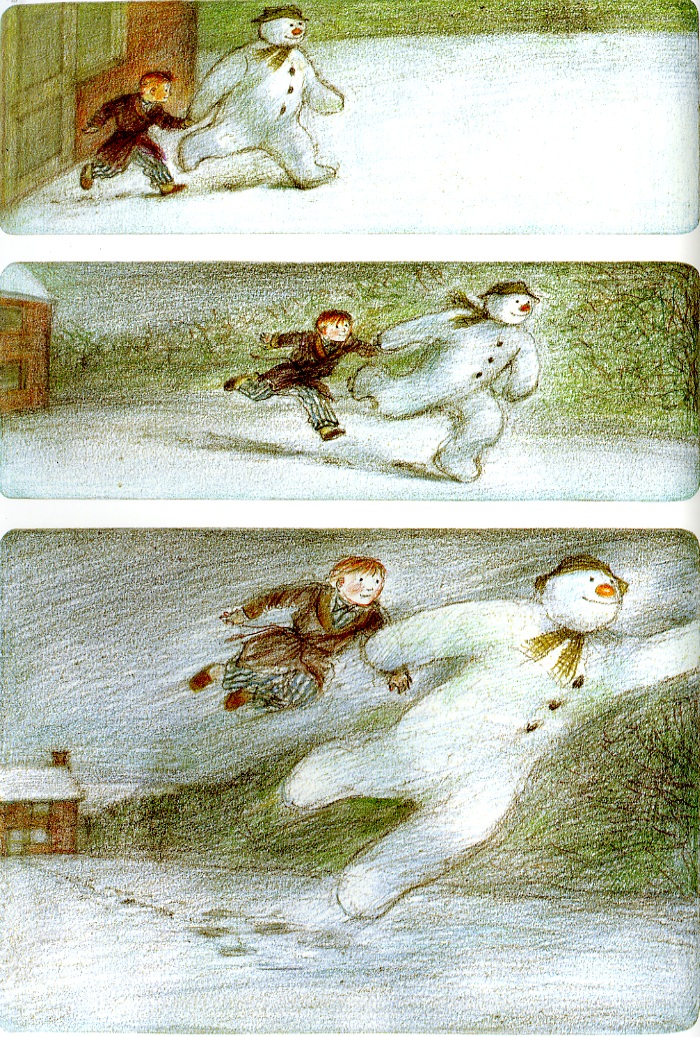
Anita Silvey on The Snowman by Raymond Briggs

When this time of year comes around, I always think of one of my favorite books first published in 1978, which truly captures the joy of playing in the snow. Although comic-book format picture books and graphic novels rule today, when Raymond Briggs used the wordless, comic-book format in The Snowman, he broke with the tradition of his time. However, the result was so magical than even adults who might have shunned comic books found themselves in love with his story.
In a book that works for preschoolers and those up to ten, a little boy awakes to find a snow-filled landscape and then goes out to build a snowman. But when the boy checks on his creation that night, it has come alive and tips its hat to the boy. Then the snowman enters the house, plays with the boy, and shares a meal with him. Finally, the two set off together on a magical flight that takes them over land and sea. In the morning, the boy goes out to find a melted snowman, an ending tinged with melancholy and loss.
As a boy, Raymond Briggs had always wanted to be a cartoonist. At fifteen, to pursue this dream, he became a student at the Wimbledon School of Art in London. Like other art students of the era, he received training in classical nineteenth-century composition, still-life and figure drawing. Eventually, he decided that he did not want to become a painter. However, when he finally returned to his childhood dream of making a comic book, he was able to bring all of his skills in draftsmanship, composition, and anatomy to The Snowman.
Although the landscape seems exotic, Briggs used his own home and garden in Sussex, at the foot of the South Downs, a few miles from Brighton. The snowman flies over the Downs to Brighton, and then the Royal Palace. Since Briggs wanted a feeling of childlike spontaneity in the drawings, he worked in pencil crayons to prepare the art. This media created a book with soft color, almost as if every page has been muted by the fallen snow.
The Snowman draws on the power of a persistent childhood fantasy—what if the snowman a child is building could come alive. This completely satisfying and moving book was adapted quite successfully as an animated film often shown on television during the holidays. As I checked this book out of the library recently, one young woman ran over and exclaimed, “I loved that book when I was a child!” Children still do. In The Snowman Raymond Briggs demonstrated how art alone, without any text, can convey a story that children delight in and remember.
Here’s a page from The Snowman:

Originally posted December 23, 2010.

Wednesday, November 16, 2011

Read to a Dog --- they're great listeners! Boston Globe

Reading to dogs may have benefits for children


Tufts University Cummings School of Veterinary Medicine student Sarah Perlmutter reads to a dog through the Grafton Public Library’s “R.E.A.D.” program. (Melody Ko/Tufts University)

What’s on your dog’s summer reading list?
A small pilot study by researchers at the Cummings School of Veterinary Medicine at Tufts University provides preliminary, but suggestive evidence that reading aloud to man’s best friend can have positive effects on children’s desire and ability to read.
“The benefit of the dog is they’re not judgmental, and they are great listeners,” said Lisa Freeman, a professor in the department of clinical sciences at Tufts, who said the study was spurred by observations that having a canine audience seemed to increase children’s engagement with reading. “It really builds their confidence.”
The health effects of pet ownership have been the subject of a number of small studies, which have been far from definitive. Some research suggests that pet ownership provides a wellness boost -- one study found that dog owners who walked their dogs were 34 percent more likely to get 150 minutes of walking exercise per week compared with non-dog owners. But others have found pet ownership correlated with negative health outcomes, like a study of 424 patients admitted to the hospital with acute coronary syndrome, which found that pet owners, especially cat owners, were more likely to die or be hospitalized again.
For years, Freeman said, she had observed what appeared to be the beneficial effects of a reading program that paired children with canine listeners. But there was no evidence to support the anecdotal observations. So the Tufts researchers designed a simple study.
Over a five-week period last summer, 18 second-graders at the Grafton Public Library were randomly divided into two groups: for 30 minutes each week, half read aloud to a dog and half read to a person.
The children were allowed to choose whatever books they wanted, and read to the same dog each week, settling in on a large dog bed with their canine companion. Freeman noted that children seemed to prefer to read books about animals, seeming to want to choose stories the dogs could relate to.
“The kids seem to particularly like the dog-themed books; they seem to think the dogs really enjoy hearing about those,” Freeman said. Those who read aloud to a person might be corrected or prompted if they made a mistake, while the children reading to the dogs would be corrected through the dogs, meaning that the handler might say something like, “I don’t think she understood that last word.”
At the end of the five weeks, the children’s abilities were measured. This was a small sample, and the results were not statistically significant, but researchers saw a signal of a difference, with an increase in the words read per minute by the children in the dog group, and a decrease among children who spent the time reading to humans.
The researchers also measured the change in the children’s attitudes toward reading using a survey that involved a cartoon cat -- Garfield. The survey showed Garfield in a range of moods, from extremely satisfied to very upset, and was used to judge childrens’ attitudes toward reading. The dog reading group showed a slight favorable increase in their feelings toward reading, and the control group underwent a slight decrease. No children dropped out of the dog program, whereas a third of the children dropped out of the control group.
Ultimately, the researchers hope to be able to expand the study to a larger group, to see whether the effects hold up.
“Many dogs -- my dog, when she recognizes the building that the reading program is in, she gets very excited, really excited to go, so they seem to enjoy this too,” Freeeman said. “That’s important -- having everybody happy on both sides of the leash is going to be very important.”
Carolyn Y. Johnson can be reached at cjohnson@globe.com.

Tuesday, November 8, 2011

Tintin!


Coming December 21st, The Adventures of Tintin is the long-awaited film version of Herge's Tintin graphic novels!  The Adventures of Tintin series was created in 1929 by a Belgian artist who called himself HergĂ©. Clever and ever-curious, Tintin is a reporter-turned-detective whose pursuit of villains, criminals, treasure and the occasional artifact takes him all over the world, along with a colorful cast of friends. HergĂ© based his stories on real-world events and cultures that had caught the Belgian national attention — from space exploration to Arab oil wars — and brought them to life for his readers in inspiring and exciting ways.

Hergé Drawing Tintin

For more about the movie, go to http://www.us.movie.tintin.com/

For more about the books, the author and the movie, go to http://us.tintin.com/

We have multiple copies of all the Tintin books (even the difficult to find The adventures of Tintin, reporter for Le Petit Vingtième, in the Congo and The adventures of Tintin, reporter for Le Petit Vingtième  --- in the Land of the Soviets !) in our juvenile graphic novel collection; stop by and check some out!

Saturday, November 5, 2011

Daisy loves to read!

 Brittany gets up close and personal with Daisy...


Friday, November 4, 2011

The 2011 Best Illustrated Children’s Books - The New York Times

November 3, 2011, 12:00 pm

The 2011 Best Illustrated Children’s Books

Sophie Blackall
The New York Times Book Review has announced its list of the 10 Best Illustrated Children’s Books of 2011. Artwork from this year’s winners will appear in the special Children’s Book section of the Book Review’s Nov. 13 issue.
The judges this year were Jeanne Lamb, the coordinator of youth collections at The New York Public Library; Lucy Calkins, the Richard Robinson Professor of Children’s Literature at Teachers College of Columbia University; and Sophie Blackall, an author and artist who has illustrated 24 books for children, including one of last year’s Best Illustrated winners, “Big Red Lollipop,” as well as “The Crows of Pearblossom,” “Spinster Goose: Twisted Rhymes for Naughty Children” and “Are You Awake?” — all published this year. They chose from among hundreds of children’s picture books published in 2011.
The Book Review’s 10 Best Illustrated Children’s Books for 2011, in alphabetical order, are: “Along a Long Road,” written and illustrated by Frank Viva (Little, Brown Books for Young Readers); “A Ball for Daisy,” written and illustrated by Chris Raschka (Schwartz & Wade); “Brother Sun, Sister Moon: Saint Francis of Assisi’s Canticle of the Creatures,” written by Katherine Paterson, illustrated by Pamela Dalton (Chronicle Books); “Grandpa Green,” written and illustrated by Lane Smith (Roaring Brook Press); “Ice,” written and illustrated by Arthur Geisert (Enchanted Lion Books); “I Want My Hat Back,” written and illustrated by Jon Klassen (Candlewick Press); “Me … Jane,” written and illustrated by Patrick McDonnell (Little, Brown Books for Young Readers); “Migrant,” written by Maxine Trottier, illustrated by Isabelle Arsenault (Groundwood Books); “A Nation’s Hope: The Story of Boxing Legend Joe Louis,” written by Matt de la Peña, illustrated by Kadir Nelson (Dial); and “A New Year’s Reunion,” written by Yu Li-Qiong, illustrated by Zhu Cheng-Liang (Candlewick Press). Next year, The New York Times Best Illustrated awards will celebrate its 60th anniversary.

Farmer Minor and Daisy!

Farmer Minor reading to Daisy

FARMER MINOR & DAISY "PIG OUT ON READING"

Daisy and Farmer Minor have performed “Pig Out on Reading” programs across the U.S. for over 10 years and Daisy is known as the “World's Most Famous Pig,” having been filmed for Belgian National TV and featured in newspapers and TV across the United States.  Daisy became the first pig ever invited inside the U.S. Capitol while on her first national tour in 2002.

Countless school principals, teachers, librarians, mayors, celebrities and hundreds of thousands of school children have kissed the famous pig; people kiss Daisy for a number of reasons ranging from promises kept to students for reading lots of books to fundraising efforts on behalf of non-profit groups, but mostly just for the wonderful love of Daisy!

Meet Daisy at the Wellesley Free Library on Saturday, November 5th from 1:30 to 3 p.m. in the Wakelin Room.  Bring your cameras to capture that pig kiss forever!  This program is recommended for families with children ages three and up.

Iron Chef with the Youth Advisory Board!

Our second annual Iron Chef competition with the Youth Advisory Board was held last night and was an unquestionable success!  Three teams competed for prizes in two categories: best-looking creation and best-tatsing creation.  The teams were limited in the colors of the foods that they could use to create their dishes --- one team was limited to shades of pink and red, another could utilize only orange, and the third team was challenged with the assignment of green foods.  Celebrity judges were on hand, including Meg Davis from the Wellesley Middle School. 

The Volcano, created by the orange team!

Inspired by an Alaskan cabin in the woods, a red team submission.

The brilliance of the green team is evident in this womb-like dish...
The orange team!

The pink team!

The green team!

Rule #1 in Iron Chef: Always know where your retainer is!

Tuesday, November 1, 2011

Recommended graphic novel

Freshman: Tales of 9th Grade Obsessions, Revelations, and Other Nonsense by Corinne Mucha; Zest Books, 2011


Sweet and goofy, this graphic novel follows a girl through her freshman year in high school, with all of its social posturing and anxiety.  Annie makes and loses friends, tries new things (with mixed results), and learns to navigate her teenage world.  Available in the Quigley Youth Room in our Youth Graphic Novel collection.

Monday, October 31, 2011

Signing for Babies!

Signing as a first language reduces frustration, deepens bonds and accelerates speech development.  Learn how to enhance early literacy skills by practicing a variety of signs.  Learn how to teach ASL to your baby.  This series of classes is for caregiver and infant (ages 2 months to pre-verbal).  Registration for the 4 week session is required.  Sign up online (http://www.libraryinsight.com/eventdetails.asp?jx=jip&lmx=385029) beginning October 17th; classes begin on Monday, October 31st.
This program is generously sponsored by the friends of the Wellesley Free Libraries.


For more information on baby signing, go to

http://abcnews.go.com/Health/story?id=1657862&page=1

Highlights from our Howl-O-Ween Party on 10-30-11

Six dogs in full costume attended our Howl-O-Ween party yesterday, some participating in one-on-one reading sessions with kids and others mingling with party guests.  Participants made spooky crafts, listened to Halloween stories, and nibbled on seasonal snacks.
Our next Read to a Dog event will be on Saturday, November 19th from 10-12;
Kids in grades K-4 can sign up for a 15 minute session with one of our fabulous reading buddies!  Sessions are 15 minutes long.  Bring your own book or read one of ours.
Pre-registration is required.  To sign up, stop by the Children’s Room at the Main Library or call 781-235-1610 ext 1108. Sign-ups start one week in advance, November 12.

Wednesday, October 26, 2011

Why Books? — The Zena Sutherland Lecture by Mo Willems in The Horn Book


It is an honor to have been asked to talk about books while they still exist. (Spoiler alert: next year’s Sutherland lecturer will be a downloadable app.)

And that, my friends, is the key to my current two-word existential dilemma: “Why books?”
In the past it was enough to say that if you get a book into a kid’s hands, you’re creating a “lifelong reader.” But why does that matter? Do we really want “lifelong readers”? Shouldn’t they at least get to take occasional bathroom breaks? Why is this extraneous question here in the middle of these other ones? And, what does reading do that makes it so special?
To be honest, books as we know them are looking pretty vulnerable right now. They can’t talk back to you. If you shake them, they don’t do things. You can’t turn them on. They don’t make sounds. They don’t have word jumbles or other not-terribly-fun games. What do they do? With all the new technological possibilities, why not file Books between Betamax and Eight-Track Tapes?
I’ve thought about this very seriously of late and I’m not out of the rabbit hole yet, so first let me just go through my own personal journey with the nitty-gritty of making books to see if there is value to be found there.
In the past eight years or so, I’ve written and illustrated numerous books, yet I really never know what I’m doing when I create a book. That is why I love it. It’s an adventure with no guarantee that it will work out in the end. I am alone in a sea of ideas, hoping to catch a current that will lead to an undiscovered land. Well, I’m not completely alone. I have the structure of my past work, and I am guided through the storms by this simple mantra: always think of your audience; never think for your audience.
This is done by putting as little as possible into the final work so as to leave room for my audience to enhance the story. As a simple test, if I re-read one of my manuscripts and I understand exactly what is happening, then the manuscript has too many words. And if I look at the images without the words and I can fully understand the story, there are too many drawings. It is only right when both words and image need each other to make any sense. They need to be as close to incomprehensible, separately, as possible.
Yes, I make incomprehensible books for illiterates.
Incomprehensible also because I never know what the book I’ve made “means.” That’s my audience’s job. You, the reader, create meaning out of the story; I just set the table. The fundamental truth of this was driven home when I read two early reviews for my first picture book, Don’t Let the Pigeon Drive the Bus! The first one said, “I love this book because it teaches perseverance. It teaches kids never to give up. To fight on.” The second review said, “I love this book because it teaches kids to value the word ‘no,’ to know when to stop.”
Here’s the thing: both reviews were right. Their authors each brought their own selves to the story and in their minds created meanings that had never occurred to me. They became the co-authors of the book, implanting the meaning that was purposefully omitted, or perhaps obscured. Because, truth be told, I don’t have any answers. I’m not interested in them.
Why would I want to write about things I know? I already know them. I prefer to write about things I don’t know, about things that perplex me, create a sense of wonder in me, or are simply weird. So I write about things like: What is a friend? How do you keep a friend? How does what you do by accident change your environment and how do you come to grips with that? Wouldn’t it be cool to drive a bus? You know, the sort of fundamental, deep emotional questions that we all have. (All rules have exceptions and my second book, Time to Pee! is one. Personally, I’ve been urinating with great success for years, so I did know what I was writing about that time. But I wasn’t sure why my kid was reluctant to do it in a particular room.)
Writing is, like any athletics, a learned skill refined only by consistent and strenuous workouts over time. I learned how to write from years and years of writing and performing sketch comedy, making short animated films, and writing cartoon strips, all of which stemmed from a deep abiding love of sketch comedy. Bill Cosby’s albums, the Monty Python television series, Peanuts comic strips—they are all perfect sketches. Clean, pure, but structured with a deep understanding of the world and how it works.
I learned how to write for children, however, with great reluctance. As fate would have it, in my strivings to be a sketch comedy writer I found myself being hired to write sketch comedy for a show that targeted children, called Sesame Street. At first I didn’t care that I was working on a kiddie show; I was writing sketch! Just like my pals on MTV or in the hipster clubs. If I squinted just right, the “kids” part of my work disappeared.
Then, over a season or two, something unexpected happened. I realized that writing for Sesame Street wasn’t easier, or even equally as difficult, as the sketch material I’d been doing previously. It was harder. I couldn’t use cultural modifiers: the entire world of pop culture references, that lazy backbone of sketch, was lost to me. Arc de Triomphe, Super Bowl, Cadillac. Those are just silly sounds to kids; they have no emotional meaning. Not because kids are stupid, but because they’re new. They just got here. All they have is jealousy, anger, love, joy, fear. Writing for a kid means you can’t exploit genres and fads and fashions. The only weapon left in your arsenal is truth.
It was revelatory and life changing (and frankly liberating: I didn’t have to keep up on pop culture, freeing up lots of time for adventures). My path was set; now I wanted—no, I was compelled—to write for people who were just starting out in life.
This began a period of great introspection. I thought long and hard about my childhood and slowly realized a fundamental truth that is the complete opposite of what everyone tells you about childhood: namely, it sucks to be a kid.
Certainly, in contrast to the life of a grownup, kids have it hard. Every piece of furniture is built to the wrong scale for you. You have to ask permission to urinate. And some adult might say no. Try this as a test: next time you’re at a dinner party, say, “May I go to the bathroom?” Then imagine your hostess saying, “No, I don’t think so. You’re staying right there. And finish those smelly vegetables. I know you want to retch. I don’t care. Eat them.”
And kids don’t have years of experience to fall back on. Every disappointment, every failure, is a world-stopping first. How do they survive? How did we all survive that? I’m not sure. But recently I’ve realized they have one shield in their lives that most of us adults have lost: they haven’t yet learned to be embarrassed.
And that’s what embarrassment is: a learned behavior.
So TV got me to want to write for unembarrassed kids. But television wasn’t done teaching me an essential key to writing.
At some point in my career I found myself being asked to create a TV show. Foolishly, I was told I could do anything I wanted; more foolishly, I did. I created a show called Sheep in the Big City. Has anybody heard of the show? Raise your hands. Okay. You six guys. Great. You made up sixty percent of my audience.
For the rest of you, the show was about a sheep. And a big city. The sheep, named Sheep, is being chased by General Specific and his henchman Private Public, members of a top-secret military organization named The Top-Secret Military Organization trying to capture this urban sheep to put it in a sheep-powered ray gun. Now why not use another sheep, you ask? Well, because they had already built the ray gun to his specifications. Mixed in with the episodes are lots of spoof commercials for products—the Oxymoron Brand of useless products.
And every episode ended with thirty seconds of a ranting Swede.
Almost as quickly as it hit the air this show was canceled. Can you believe it?
I couldn’t.
I’d worked so long and so hard, ensuring that every joke was as funny, or as weird, as possible. Still, very, very few people enjoyed it. I was flummoxed.
The real reason why the show was canceled came not from the network but from a ten-year-old on some message board who wrote, “I don’t like this show because the writer is trying too hard.” Trying too hard? That shocked me to my core.
I could not think of another industry where this would be a problem. “Oh, man. Y’know that plumber, Joe? What is up with that guy? He shows up early. He comes in, he plumbs the hell out of the house, doesn’t take a single cigarette break, I don’t see butt once. He’s working soooo hard…I don’t trust him.”
But in writing it’s different. The people watching Sheep in the Big City or reading my stories are not interested in me or the work I do. It shouldn’t look like work to them. It’s just a story. A magical thing that suddenly, effortlessly, appears and entertains and provokes. Certainly such a thing can’t be made. The lesson is, if you’re not invisible, you’re not doing your job. So, work harder until no one sees you.
I should have known that. I should have known better.
You know, I started out doing stand-up comedy when I was in high school. And the reason I did was because the comedy club was the only place I could go and be guaranteed that no one would laugh at me. But over time you develop those muscles. You write joke after joke after joke after joke, and, ever so slowly, you learn what doesn’t work. What you learn is not “what is funny” but “what is not funny.” So when you’re writing, you write to get rid of all the not-funny stuff until what’s left, hopefully, works. I want to have as few words as possible. I want the whole story to just be hanging by a thread. So my audience will become invested in it and save it.
It’s the same with my images. Everything I do is reductive. I make my drawings as simple as possible to the point of abstraction. Put as little in as possible. Because kids can “make” books, I consciously design my characters so that they can be easily copied by a five-year-old.
Every month, I get a box of fan mail—it’s just awesome. Kids send me their books. Their actual books. Don’t Let the Pigeon Operate the Catapult. Don’t Let the Pigeon Audit Your Neighbor. The Pigeon Gets a Cell Phone. All kinds of just amazing stuff, and that’s the highest possible compliment; that’s the ultimate goal.
It’s how I got started. I started out drawing Charlie Brown pictures. I loved it so much I wrote to Charles Schulz once when I was five and said, “Dear Mr. Schulz, may I have your job when you die?” Man, I loved Charlie Brown. I grew up in the early seventies, and every other pop cultural character was blissfully happy. Remember? The landscape was filled with gleeful rodents on lithium running across the screen. I felt bad that I wasn’t as happy as those mice. But there was always “Chuck.” A kid whose life was worse than mine. Awesome.
That comic strip was printed on cheap newsprint. It was meant to be thrown away, unlike a piece of art. But it was useful. It was useful to me. That corner of the newspaper that showed up every day gave me more consolation in my lonely childhood world than anyone or anything.
That’s what I want my books to be: utilitarian. You don’t drink coffee out of a mug because it’s a work of art. You drink out of a mug because it works, then you worry if it is pretty or not. In the same way, whatever ideas you’re going to pour into my book, I need to make sure it can hold them first. Because that’s all a book can do. It can hold just two ideas: the author’s and the audience’s.
But the book doesn’t work, it can’t work, unread.
So back to my question of “Why books?” What if books are better because they don’t do things, because they can’t do things? What if the thing that makes books great, that makes them essential, is that books need us? They’re simple. You invest in them and become part of them. You contribute. They can be read, but they can also be played. I’m not really interested in you guys reading my books a hundred times; read it twenty times and then make your own story. Go from consuming a story to creating your own. This is a magical thing to me.
I have a running machine in my house, and if I set that machine for twenty minutes of fast running and leave the room to get some tea and fried eggs, it doesn’t know the difference! Nor, I might add, does it care.
And I think that’s what most enhanced digital books are at this point. With all their bells and whistles and word jumbles and assorted narrative killers, after we turn them on, they don’t need us. Turn it on and leave the room, and the book will read itself.
But a real book is helpless. It needs us desperately. We have to pull it off the shelf. We have to open it up. We have to turn the pages, one by one. We even have to use our imagination to make it work. What does Elephant Gerald sound like? Is the Pigeon a boy or a girl? Does Leonardo the Terrible Monster live in the city or in the country?
We have to do all of that, we have to do the work with our little minds and our flapping flights of fancy. So, suddenly, that book is not just a book; it’s our book. We’re the ones making it work. We’re the ones making it sing. Right there in our chairs as we gently flip the pages, we are, at our own pace, creating a living story just by reading.
And you don’t have to turn off a book during takeoff and landing.
So, maybe books work because they make us work. Maybe we need them for needing us, just like we need real friends, not the digital imitations on Facebook.
Thank you for bearing with me.

Tuesday, October 25, 2011

Highly recommended...

'Wonderstruck': A Novel Approach To Picture Books


September 13, 2011

A Wordless World: The story of Rose, a deaf little girl in Brian Selznick's Wonderstruck, is told primarily in pictures. "We experience [Rose's] story in a way that perhaps might echo the way she experiences her own life," Selznick explains.
Brian Selznick A Wordless World: The story of Rose, a deaf little girl in Brian Selznick's Wonderstruck, is told primarily in pictures. "We experience [Rose's] story in a way that perhaps might echo the way she experiences her own life," Selznick explains.
September 13, 2011
It's not often that a writer can illustrate his own books, but Brian Selznick is that rare find. He began his career as an artist collaborating with authors on children's books. But he gradually realized that he wanted to tell his own stories in both words and pictures — and to do that, Selznick invented a unique narrative device.
Wonderstruck
Wonderstruck is both a novel and a picture book, a form Selznick first experimented with in The Invention of Hugo Cabret, when he had the idea of telling a story in much the same way that film does.
"I thought: Is there a way of combining what the cinema can do with panning, and zooming in and out, and edits, and what a picture book can do with page turns, and what a novel does?" Selznick says.
Selznick's illustrations work like a camera, zooming in on details and following his characters around as they move through the world. In the beginning of The Invention of Hugo Cabret, the reader follows a boy through a grate in the wall, down a hallway, to an old man in a toy booth who sees a clock, and behind the number 5 in the clock, there's the boy ... (Click here to see that opening sequence of drawings.)
In Wonderstruck, Selznick wanted to take this narrative experiment a step further. "I had this idea to try to tell two different stories," he says. "What if I told one story just with pictures, and then told a completely different story that was set 50 years later with words? And then had these two separate stories weave back and forth until they came together at the end?"
Wonderstruck is the story of Rose and Ben, a young boy and girl who live years and worlds apart. By the end of the book, the reader learns they have a special connection. But from early on, they have one thing in common: She is deaf, and he loses his hearing when he is struck by lightning.
Selznick says the idea for the book began forming when he saw a documentary about deafness and deaf culture. One of the deaf educators emphasized how hyper-attuned deaf people are to the visual world. So Selznick set out to tell the story of a deaf character in pictures. "We experience [Rose's] story in a way that perhaps might echo the way she experiences her own life," he explains.
Hugo and Isabelle look out over Paris from behind a clock face in Selznick's The Invention of Hugo Cabret.
Rose's story, told almost entirely through Selznick's compelling black-and-white illustrations, alternates with Ben's story, which unfolds in written form. At first, the reader is not sure how the two stories relate, but here and there, the characters' worlds collide. Both get caught in a storm, both go in search of their parents, both find refuge in New York's Museum of Natural History (one of Selznick's favorite destinations when he was a kid growing up in New Jersey). When Ben and Rose finally do meet, Selznick says, the book becomes all about how we communicate with each other.
"At the end of the story, we have scenes where there's a deaf character who signs, a hearing character who signs, and a deaf character who doesn't sign — and they all have to have a conversation," Selznick says. "And so who speaks, who writes, who can sign ... it all becomes mixed up until they can figure out a way to communicate."

More On Brian Selznick's Work

Creating these books is a complicated process, Selznick says, and he is always a little surprised in the end when everything comes together. When he's in the middle of it, it's a little like looking for buried treasure.
"It's sort of like going through a treasure map backwards in a certain way, where I know what I want it to be, but I don't know how to get there," he says. "It does end up feeling like I have been on this really exciting journey that I ultimately hope that the reader will be excited to be on, too."
A writer and artist who is fascinated with film, Selznick is about to see a fantasy come true: In November, the film version of The Invention of Hugo Cabret, directed by Martin Scorcese, will be released on the big screen.

Terrariums @ the library!

Kids had a great time creating terrariums on Saturday as part of our Wellesley Reads Together programming!

And so did our librarians, Geralyn and Michele!

Wednesday, October 19, 2011

What we're reading right now...


While Small Steps is the sequel to Holes, it is not necessary to have read Holes to lose yourself completely in Small Steps.  This 2006 follow-up addresses class, race, gender and physical disabilities in a refreshing and thoughtful manner not often encountered in children's literature.  Armpit, our protagonist, is an African-American teenager who spent time in a juvenile dentention center for commiting a violent crime that landed two victims in the hospital.  Back at home after incarceration, Armpit has plans, his "small steps" toward  a successful and honest life. We see Armpit continually striving to do the right thing, even when others around him try to block his path.  Overcoming stereotypes and respecting others are major themes in this work and Armpit's belief in himself and his kindness towards others make this an important (but not didactic) book for middle school and older readers.


School Library Journal Review
Gr 5-8-This sequel to Holes (Farrar, 1998) focuses on Armpit, an African-American former resident of Tent D at Camp Green Lake. It's two years after his release, and the 16-year-old is still digging holes, although now getting paid for it, working for a landscaper in his hometown of Austin, TX. He's trying to turn his life around, knowing that everyone expects the worst of him and that he must take small steps to keep moving forward. When X-Ray, his friend and fellow former detainee at the juvenile detention center, comes up with a get-rich-quick scheme involving scalping tickets to a concert by teenage pop star Kaira DeLeon, Armpit fronts X-Ray the money. He takes his best friend and neighbor, Ginny, a 10-year-old with cerebral palsy, to the concert and ends up meeting Kaira, getting romantically involved, and finally becoming a hero by saving her life when her stepfather tries to kill her and frame him. Small Steps has a completely different tone than Holes. It lacks the bizarre landscape, the magical realism, the tall-tale quality, and the heavy irony. Yet, there is still much humor, social commentary, and a great deal of poignancy. Armpit's relationship with Ginny, the first person to care for him, look up to him, and give his life meaning, is a compassionate one. Like Holes, Small Steps is a story of redemption, of the triumph of the human spirit, of self-sacrifice, and of doing the right thing. Sachar is a master storyteller who creates memorable characters.
-Connie Tyrrell Burns, Mahoney Middle School, South Portland, ME (c) Copyright 2010. Library Journals LLC, a wholly owned subsidiary of Media Source, Inc. No redistribution permitted.

Roger Hargreaves books now available in vast quantities!


Are you a fan of the Little Miss and Little Mr. books by Roger Hargreaves?  Stop by the children's room and check out our new bin of books!  These popular titles have come into fashion once again and the children's room has been met with many requests for these books; in response, we have purchased multiple copies of the books in this series and we are pleased to say that they are absolutely flying off the shelves!
 
"Roger Hargreaves was born in 1935 in Cleckheaton, Yorkshire, England. He is the British cartoonist who created the likes of Mr. Nosey and Mr. Grumpy, the simple little cartoon Mr. Men and Little Miss characters and books.
He was the creative director for an advertising agency in London when he got the idea for his books. He first began to market the idea in the early '70's, starting with Mr. Men, which appeared in books, BBC cartoons and as a comic strip in the Daily Mirror. The characters spawned over 700 related products and brought along the introduction of the Little Miss books introduced in the early '80s.
The two series reached worldwide sales of 85 million volumes and were printed in over 20 different languages. Hargreaves died on September 12, 1988 in Kent, England."
 
- Bowker Author Biography

Tuesday, October 11, 2011

Arthur's Nose, from Anita Silvey's Children's Book-a-Day Almanac

Grandparent Kits are here!

We have Grandparent Kits! The Wellesley Free Library now has a limited number of Grandparent Kits available; these kits contain books and activity ideas and can be borrowed for one week. The kits can be customized according to age and special interests. To request a kit, call the children's department at 781-235-1610 x 1108.

Monday, October 3, 2011

We now have Playaway Views!


What is a Playaway View?

  • Portable
    Includes a head-phone jack and speakers
  • Convenient
    Pre-loaded content; no internet or downloads needed
  • Durable and Scratch-Resistant
    Made with kids in mind
  • Multiple Videos
    Each View holds hours of great content,
    bundling curated content just for you
  • Chargeable
    Simply use the included standard AC Adaptor
Come in and check one out!

Drawing From Memory by Allen Say

My new favorite book!  A must-read for Allen Say fans and aspiring artists.

 
School Library Journal Review
Gr 4 Up-Say tells the story of how he became an artist through a vibrant blend of words and images. Beginning with his boyhood in World War II-era Japan, he traces his life-changing relationship with Noro Shinpei, an illustrious cartoonist who became his surrogate father figure and art mentor. Illustrations are richly detailed and infused with warmth. Exquisite use of light makes night scenes glow, and the mid-20th-century Tokyo setting is captured with vivid authenticity. A variety of media and artistic styles, including full-color paintings, black-and-white sketches, photographs, and comic-book panels, adds texture and depth to the narrative. Fans of the artist's work will take particular delight in seeing sketches from his student days. Simple, straightforward sentences and a conversational narration in combination with a wealth of images will appeal to aspiring artists and reluctant readers alike. This book covers much of the same material as Say's autobiographical novel, The Ink-Keeper's Apprentice (Harper & Row, 1979), but the lively mix of art and text will draw in a new generation and a slightly younger audience. The somewhat abrupt ending, with Say moving to the United States, may leave readers wishing for a more extended epilogue or sequel, but that is simply because his story is so engaging. Readers of all ages will be inspired by the young Say's drive and determination that set him on a successful career path.-Allison Tran, Mission Viejo Library, CA (c) (c) Copyright 2010. Library Journals LLC, a wholly owned subsidiary