

Ever since Chris Van Allsburg’s birthday last month, we’ve been feeling a surge of appreciation for the plethora of beautiful picture books in our lives. In fact, we think some of the loveliest illustrations we’ve ever seen have been in books (or maybe that’s just the association with a great story talking), so we decided to round up a few of the most beautiful children’s books — at least according to us. Keep in mind: we’re going for beauty, not iconic status — so Tenniel’s Alice drawings and a few other iconic, innovative illustrations, while dear to us, don’t make the cut. Leaf through our picks for the most mindblowingly beautiful picture books after the jump, and since we can only draw from our own personal knowledge and tastes, and we know there are scores upon scores of gorgeous children’s books out there (thank goodness), be sure to add any other favorites of yours to our list in the comments!
Thursday, September 27, 2012
Wednesday, September 19, 2012
Wellesley resident’s book teaches value of daily good deeds


Liz Suneby with her new children’s book .
Wellesley resident’s book teaches value of daily good deeds
Photos from the American Girl Tea Party


Wednesday, August 22, 2012
Hey! Look at us in Wellesley Weston magazine...

Good old Mariah, as mentioned in Wellesley Weston magazine.
http://wellesleywestonmagazine.epubxp.com/issue/78488/103
Monday, August 20, 2012
From Esme Raji Codell, a bit about classroom discipline
What also comes to mind is a passage from Farmer Boy by Laura Ingalls Wilder, describing a situation in a frontier classroom:
"These big boys came...to thrash the teacher and break up the school. They boasted that no teacher could finish the winter term at that school, and no teacher ever had. This year the teacher was a slim, pale young man. His name was Mr. Corse. He was gentle and patient, and never whipped little boys because they forgot how to spell a word. Almanzo felt sick inside when he thought how the big boys would beat Mr. Corse. Mr. Corse wasn't big enough to fight them."
The
story continues, describing insolence and disruptive behavior in the
one-room schoolhouse by the band of boys, led by the teenager "Big
Bill," and it is revealed that these boys have caused death to teachers
in the past. The other children cannot concentrate on their work, or
complete their lessons, in anticipation of the inevitable
confrontations. Little Almanzo confides in his father, "I wish I was big
enough to fight 'em!"
"'Son, Mr. Corse was hired out to teach the school,' Father answered. "The school trustees were fair and above board with him; they told him what he was undertaking. He undertook it. It's his job, not yours.'
'But maybe they'll kill him!' Almanzo said.
'That's his business,' said Father. 'When a man undertakes a job, he has to stick to it till he finishes it. If Corse is the man I think he is, he'll thank nobody for interfering.'
....Big Bill tore off his coat, yelling, 'Come on boys!' He rushed up the aisle. Almanzo felt sick inside; he didn't want to watch it, but he couldn't help it.
Mr. Corse stepped away from his desk. His hand came from behind the desk lid, and a long, thin, black streak hissed through the air.
It was a blacksnake ox-whip fifteen feet long. Mr. Corse held the short handle, loaded with iron, that could kill an ox. The thin, long lash coiled around Bill's legs, and Mr. Corse jerked. Bill lurched and almost fell. Quick as black lightning the lash circled and stuck and coiled again, and again Mr. Corse jerked."

illustration by Garth Williams
In this frontier memoir, Mr. Corse
wins the battle and the war, and regains classroom control in a society
where the parental attitude was "if the teacher has to thrash you again,
I'll give you a thrashing you remember." The problem of insanely
brutal threats to classroom management are not new in the American
classroom, nor are the extreme responses of educators.
From the Horn Book: Reading Along the Gender Continuum
Reading Along the Gender Continuum
August 20, 2012 By Leave a Comment
Having grown up in the Free to Be generation, I’ve tried as a parent to steer clear of limiting gender norms in raising, and reading to,
my son. We’ve read about boys and girls of all types, and (just as
Hilary Rappaport describes in her May/June 2012 Horn Book article “On the Rights of Reading and Girls and Boys”), his preferences never seemed to hinge on the gender presented on the covers or through the characters. We’ve loved stories in which characters cross gender boundaries, such as Horace and Morris but Mostly Dolores and The Princess Knight and the classic William’s Doll, as well as stories that seem to ignore gender, such as my son’s one-time favorite, Ten Minutes till Bedtime, complete with discussions about which pronoun we should use for the main character.
I had never heard of the Rainbow Magic books (Scholastic) when my son, then five, announced that he wanted to read them; it soon became apparent that they were the new “in” books with his friends at school (kids with names like Emily and Ava and Sophie). So we borrowed Ruby the Red Fairy from the library, and he loved it: the good kids and the bad villains, the magic, the predictable formula, the tidy resolution. We moved on from the Rainbow Fairies to the Weather Fairies, and I told my partner it was his turn to read the next set (there being only so much trite writing I am willing to endure for the sake of crossing gender borders). As our son became an independent reader, we told him that if he wanted to read more Rainbow Magic books, he’d have to read them to himself, and read them he did.
One day when he was getting ready for a playdate, he said he wanted to hide his fairy books so no one would tease him. He didn’t think there was anything wrong with liking them, but he was beginning to recognize that some other kids might. The books were hidden for a while, and then when I started teaching children’s literature and asked if I could bring them in to work to show in my class, he said “sure.” He had moved on, continuing to devour books as he raced through the Littles and Humphrey the hamster, Little Wolf and Ramona, Hank Zipzer and of course the Magic Tree House. There weren’t “girl books” and “boy books.” There were just books.
He switched to a new school in first grade, and since then the books he has brought home from the school library seem to be very gender-typed: Justice League; Big Nate; several iterations of Star Wars. He tells me which kids checked the books out before him, and which ones are waiting to get them next (kids with names like Jack and Connor and Joaquin). He does enjoy these “for boys!”–blazened titles, despite the narrowing focus of the type of reading he is supposed to like. Though part of me mourns this loss, knowing there are many less-obviously-boy-oriented books that would appeal to him too, he is still reading passionately. But how is he being socialized to fit into gender categories? And what if a kid wants (or needs) to fight the categories? How much conviction does a second-grade boy need to carry a book with a pink cover out of the library?
My interest in the presentation of gender in reading materials has shifted over the past three years as I’ve begun to contemplate literary gender roles not just from a parental perspective but also from a professional one, teaching children’s literature to future teachers. Recently, one of my college students wrote a paper referencing The Secret Garden, and as I looked for a copy of the book in the library catalog I saw cover after cover that seemed designed to appeal to a specific category of readers: bookish girls. I do believe that we should work to change society so that we don’t have these gender limitations, and indeed we should not judge books by their covers (even though we know kids do, and will continue to do so). Yet by having images and colors that play into gender norms, aren’t book covers (or the publishers who select them) judging their readers? By putting a sparkly pink cover on a Rainbow Magic fairy book, has it been preordained that only girls need bother picking it up? By highlighting the fairies and jewels and glitter, do we inadvertently approve and promote the idea that boys won’t read about girls?
 I have fallen into this trap, too. When I check books out for my class, if I think they might interest my son, I put them in his room until I need them; books I think are too old for him or not to his taste I set on my desk. One day he saw The Doll People on top of my pile and asked about it. Of course I said he could look at it, and in a matter of minutes he was immersed. In a couple of days it was read, as were the others in the series as quickly as we could borrow them. What had influenced me to sort that book into the desk pile? Was it the cover art (dolls, dollhouse, even a heart-shaped lock)? The flourish-filled font? The female authors? The word doll in the title? What if it had said mini-figure instead? The subconscious notions of my adult mind didn’t speak to the real child in my house. The avowed feminist had fallen for the old stereotypical assumptions.

Yet even more layers of assumptions are inherent in this discussion, identifying children as gender normative, boy or girl. On the rare occasion when titles like 10,000 Dresses or I Am J come out in which main characters identify as transgender, these books are praised—and rightly so—for providing bibliotherapeutic relief for young people who are transgender or questioning whether they may be. But our response to books portraying transgender characters reveals that we are once again falling into old patterns of categorization. Sure, we’ve added another perspective on gender, but we still want to separate people into clear-cut groupings: either you’re transgender, or you’re not. We believe we can embrace transgender children and a male/female dichotomy simply by reassigning these children to the appropriate gender role — swapping Captain Underpants for Babymouse.
The reality, however, is that many children are gender variant (with interests and behaviors persistently outside of typical cultural gender norms) and at different points in their lives might be living or exploring at various places along the gender identity continuum (see, for example, Ruth Padawer’s article “What’s So Bad About a Boy Who Wants to Wear a Dress?” in the August 12, 2012 New York Times Magazine). Assigning labels to these places isn’t as important as having a rich understanding of the ways gender is presented in books; a rich understanding of how kids may be presenting and exploring their gender and gender identity; and the skills to connect the two.
To gain that understanding and those skills, we need to remember not to judge children by the “covers” they present. One child may be presenting as a boy only because no other option is permitted in that family. Another may present as a “girly girl” in a phase of experimentation, but may want to both wear pink and study science. Maybe we have to realize that there can be many paths to the same summit, and some of them might involve a detour through an obsession with Disney Princesses and Barbie (and the narrowed roles they suggest), as was the case for one transgender girl I know.
So I would propose that we modify our language, speaking not of “Girl Books and Boy Books,” but of books across gender. To the advice contained within the section of the same name in Roger Sutton’s essay in A Family of Readers (Candlewick), I would offer a modification (in italics below): “The best thing you can give to a would-be, could-be reader, regardless of gender, gender identity, or gender presentation, is access to a wide variety of reading possibilities among which he or she can find what seems just right, labels be damned.” And yet, peer pressure is a mighty force with which to contend, particularly for gender-variant or transgender children, who are routinely targeted for teasing and bullying. A boy who otherwise aligns with gender stereotypes may be given a pass for reading Ivy + Bean, but one who is already ridiculed for being effeminate may find taking such a risk much more dangerous.
So where do we find good books for the children along the middle of the continuum? What do we suggest to the child who feels like a girl but is called a boy (or vice versa), the kids who are exploring gender, or the ones who want to understand a friend who is exploring gender?
It’s not enough to have content with gender-diverse appeal; packaging matters too. Some authors deftly manage to weave rich characters of diverse genders into their books only to be faced with the loss of potential readers through covers that invite just one segment of the gender spectrum, such as the misleading suggestion of romantic fiction on the cover of Phoebe Stone’s engaging historical mystery, The Romeo and Juliet Code. Occasionally publishers make changes between editions, as happened with Linda Sue Park’s Keeping Score: the paperback edition sports not only a new font and image (a dog and a baseball) on the cover but a new subtitle as well, all significant improvements over the cursive lettering and girl-centric picture on the hardcover.

Gender variant girls in many ways have it easier; in my work in the schools, they are comfortable picking up Diary of a Wimpy Kid and adore the Harry Potter books with no reservations. But let’s make sure it stays that way, while opening doors for boys to explore diverse genres. Let’s damn the labels, but let’s actively try to defy them too. There are lots of great examples with titles and cover art that don’t play into the trappings of gender. Books with girls as main characters should appeal to many kids, and titles such as Rules and Out of My Mind (both with goldfish on the covers), When You Reach Me (with its clever display of symbols), and Zebrafish (with a diverse group of kids pictured) are excellent models of inviting potential readers rather that prescribing them. The Judy Moody and Stink books serve as positive examples as well, with their neutral book covers and mix of central characters. The Hunger Games series demonstrates the potential for strong sales with packaging that appeals to all readers. We do want all kids to read more, regardless of how they identify along the gender continuum. And ideally all kids will feel safe to explore gender through their reading, in order (as Roger Sutton put it in his September/October 2007 Horn Book editorial) “to independently and privately assume whatever (not whichever) genders [they] like.” And then maybe, through access to the perspectives these books provide, they can come closer to finding an authentic gender identity and, in the best-case scenario, finding an identity as a reader as well.
I Am J (Little, Brown, 2011) by Cris Beam [High School]
The World According to Humphrey (Putnam, 2004) by Betty G. Birney [Primary, Intermediate]
Be Who You Are (AuthorHouse, 2010) by Jennifer Carr; illus. by Ben Rumback [Primary]
Beezus and Ramona (Morrow, 1955) by Beverly Cleary; illus. by Louis Darling [Intermediate]
The Hunger Games (Scholastic, 2008) by Suzanne Collins [Middle School, High School]
Out of My Mind (Atheneum, 2010) by Sharon M. Draper [Intermediate]
Peter H. Reynolds and FableVision Present Zebrafish (Atheneum, 2010) by Sharon Emerson; illus. by Renée Kurilla [Intermediate, Middle School]
10,000 Dresses (Seven Stories, 2008) by Marcus Ewert; illus. by Rex Ray [Primary]
Born to Fly (Delacorte, 2009) by Michael Ferrari [Intermediate]
The Princess Knight (Scholastic, 2004) by Cornelia Funke; illus. by Kerstin Meyer [Preschool, Primary]
Hoot (Knopf, 2002) by Carl Hiaasen (also Flush (2005), Scat (2009), and Chomp (2012)) [Intermediate, Middle School]
Operation Yes (Levine/Scholastic, 2009) by Sara Lewis Holmes [Intermediate, Middle School]
Horace and Morris but Mostly Dolores (Atheneum, 1999) by James Howe; illus. by Amy Walrod [Primary]
Pinky and Rex and the Bully (Atheneum, 1996) by James Howe; illus. by Melissa Sweet [Primary]
Diary of a Wimpy Kid (Amulet/Abrams, 2007) by Jeff Kinney [Intermediate, Middle School]
Rules (Scholastic, 2006) by Cynthia Lord [Intermediate]
The Doll People (Hyperion, 2000) by Ann M. Martin and Laura Godwin; illus. by Brian Selznick [Primary, Intermediate]
Jeremy Fink and the Meaning of Life (Little, Brown, 2006) by Wendy Mass [Intermediate, Middle School]
Judy Moody (Candlewick, 2000) by Megan McDonald; illus. by Peter H. Reynolds [Primary, Intermediate]
Stink (Candlewick, 2005) by Megan McDonald; illus. by Peter H. Reynolds [Primary]
The Littles (Scholastic, 1967) by John Peterson; illus. by Roberta Carter Clark [Primary]
Ten Minutes till Bedtime (Putnam, 1998) by Peggy Rathmann [Preschool]
Harry Potter and the Sorcerer’s Stone (Levine/Scholastic, 1998) by J.K. Rowling; illus. by Mary GrandPré [Intermediate]
Bluefish (Candlewick, 2011) by Pat Schmatz [Middle School]
When You Reach Me (Lamb/Random, 2009) by Rebecca Stead [Intermediate, Middle School]
Little Wolf’s Book of Badness (Carolrhoda/Lerner, 1999) by Ian Whybrow; illus. by Tony Ross [Primary, Intermediate]
Countdown (Scholastic, 2010) by Deborah Wiles [Intermediate]
Parrotfish (Simon, 2007) by Ellen Wittlinger [High School]
Peace Locomotion (Putnam, 2009) by Jacqueline Woodson [Intermediate]
William’s Doll (Harper & Row, 1972) by Charlotte Zolotow; illus. by William Pene du Bois [Preschool, Primary]
I had never heard of the Rainbow Magic books (Scholastic) when my son, then five, announced that he wanted to read them; it soon became apparent that they were the new “in” books with his friends at school (kids with names like Emily and Ava and Sophie). So we borrowed Ruby the Red Fairy from the library, and he loved it: the good kids and the bad villains, the magic, the predictable formula, the tidy resolution. We moved on from the Rainbow Fairies to the Weather Fairies, and I told my partner it was his turn to read the next set (there being only so much trite writing I am willing to endure for the sake of crossing gender borders). As our son became an independent reader, we told him that if he wanted to read more Rainbow Magic books, he’d have to read them to himself, and read them he did.
One day when he was getting ready for a playdate, he said he wanted to hide his fairy books so no one would tease him. He didn’t think there was anything wrong with liking them, but he was beginning to recognize that some other kids might. The books were hidden for a while, and then when I started teaching children’s literature and asked if I could bring them in to work to show in my class, he said “sure.” He had moved on, continuing to devour books as he raced through the Littles and Humphrey the hamster, Little Wolf and Ramona, Hank Zipzer and of course the Magic Tree House. There weren’t “girl books” and “boy books.” There were just books.
He switched to a new school in first grade, and since then the books he has brought home from the school library seem to be very gender-typed: Justice League; Big Nate; several iterations of Star Wars. He tells me which kids checked the books out before him, and which ones are waiting to get them next (kids with names like Jack and Connor and Joaquin). He does enjoy these “for boys!”–blazened titles, despite the narrowing focus of the type of reading he is supposed to like. Though part of me mourns this loss, knowing there are many less-obviously-boy-oriented books that would appeal to him too, he is still reading passionately. But how is he being socialized to fit into gender categories? And what if a kid wants (or needs) to fight the categories? How much conviction does a second-grade boy need to carry a book with a pink cover out of the library?
My interest in the presentation of gender in reading materials has shifted over the past three years as I’ve begun to contemplate literary gender roles not just from a parental perspective but also from a professional one, teaching children’s literature to future teachers. Recently, one of my college students wrote a paper referencing The Secret Garden, and as I looked for a copy of the book in the library catalog I saw cover after cover that seemed designed to appeal to a specific category of readers: bookish girls. I do believe that we should work to change society so that we don’t have these gender limitations, and indeed we should not judge books by their covers (even though we know kids do, and will continue to do so). Yet by having images and colors that play into gender norms, aren’t book covers (or the publishers who select them) judging their readers? By putting a sparkly pink cover on a Rainbow Magic fairy book, has it been preordained that only girls need bother picking it up? By highlighting the fairies and jewels and glitter, do we inadvertently approve and promote the idea that boys won’t read about girls?
I have fallen into this trap, too. When I check books out for my class, if I think they might interest my son, I put them in his room until I need them; books I think are too old for him or not to his taste I set on my desk. One day he saw The Doll People on top of my pile and asked about it. Of course I said he could look at it, and in a matter of minutes he was immersed. In a couple of days it was read, as were the others in the series as quickly as we could borrow them. What had influenced me to sort that book into the desk pile? Was it the cover art (dolls, dollhouse, even a heart-shaped lock)? The flourish-filled font? The female authors? The word doll in the title? What if it had said mini-figure instead? The subconscious notions of my adult mind didn’t speak to the real child in my house. The avowed feminist had fallen for the old stereotypical assumptions.Yet even more layers of assumptions are inherent in this discussion, identifying children as gender normative, boy or girl. On the rare occasion when titles like 10,000 Dresses or I Am J come out in which main characters identify as transgender, these books are praised—and rightly so—for providing bibliotherapeutic relief for young people who are transgender or questioning whether they may be. But our response to books portraying transgender characters reveals that we are once again falling into old patterns of categorization. Sure, we’ve added another perspective on gender, but we still want to separate people into clear-cut groupings: either you’re transgender, or you’re not. We believe we can embrace transgender children and a male/female dichotomy simply by reassigning these children to the appropriate gender role — swapping Captain Underpants for Babymouse.
The reality, however, is that many children are gender variant (with interests and behaviors persistently outside of typical cultural gender norms) and at different points in their lives might be living or exploring at various places along the gender identity continuum (see, for example, Ruth Padawer’s article “What’s So Bad About a Boy Who Wants to Wear a Dress?” in the August 12, 2012 New York Times Magazine). Assigning labels to these places isn’t as important as having a rich understanding of the ways gender is presented in books; a rich understanding of how kids may be presenting and exploring their gender and gender identity; and the skills to connect the two.
To gain that understanding and those skills, we need to remember not to judge children by the “covers” they present. One child may be presenting as a boy only because no other option is permitted in that family. Another may present as a “girly girl” in a phase of experimentation, but may want to both wear pink and study science. Maybe we have to realize that there can be many paths to the same summit, and some of them might involve a detour through an obsession with Disney Princesses and Barbie (and the narrowed roles they suggest), as was the case for one transgender girl I know.
So I would propose that we modify our language, speaking not of “Girl Books and Boy Books,” but of books across gender. To the advice contained within the section of the same name in Roger Sutton’s essay in A Family of Readers (Candlewick), I would offer a modification (in italics below): “The best thing you can give to a would-be, could-be reader, regardless of gender, gender identity, or gender presentation, is access to a wide variety of reading possibilities among which he or she can find what seems just right, labels be damned.” And yet, peer pressure is a mighty force with which to contend, particularly for gender-variant or transgender children, who are routinely targeted for teasing and bullying. A boy who otherwise aligns with gender stereotypes may be given a pass for reading Ivy + Bean, but one who is already ridiculed for being effeminate may find taking such a risk much more dangerous.
So where do we find good books for the children along the middle of the continuum? What do we suggest to the child who feels like a girl but is called a boy (or vice versa), the kids who are exploring gender, or the ones who want to understand a friend who is exploring gender?
It’s not enough to have content with gender-diverse appeal; packaging matters too. Some authors deftly manage to weave rich characters of diverse genders into their books only to be faced with the loss of potential readers through covers that invite just one segment of the gender spectrum, such as the misleading suggestion of romantic fiction on the cover of Phoebe Stone’s engaging historical mystery, The Romeo and Juliet Code. Occasionally publishers make changes between editions, as happened with Linda Sue Park’s Keeping Score: the paperback edition sports not only a new font and image (a dog and a baseball) on the cover but a new subtitle as well, all significant improvements over the cursive lettering and girl-centric picture on the hardcover.
Gender variant girls in many ways have it easier; in my work in the schools, they are comfortable picking up Diary of a Wimpy Kid and adore the Harry Potter books with no reservations. But let’s make sure it stays that way, while opening doors for boys to explore diverse genres. Let’s damn the labels, but let’s actively try to defy them too. There are lots of great examples with titles and cover art that don’t play into the trappings of gender. Books with girls as main characters should appeal to many kids, and titles such as Rules and Out of My Mind (both with goldfish on the covers), When You Reach Me (with its clever display of symbols), and Zebrafish (with a diverse group of kids pictured) are excellent models of inviting potential readers rather that prescribing them. The Judy Moody and Stink books serve as positive examples as well, with their neutral book covers and mix of central characters. The Hunger Games series demonstrates the potential for strong sales with packaging that appeals to all readers. We do want all kids to read more, regardless of how they identify along the gender continuum. And ideally all kids will feel safe to explore gender through their reading, in order (as Roger Sutton put it in his September/October 2007 Horn Book editorial) “to independently and privately assume whatever (not whichever) genders [they] like.” And then maybe, through access to the perspectives these books provide, they can come closer to finding an authentic gender identity and, in the best-case scenario, finding an identity as a reader as well.
Books with Gender-Diverse Appeal
Anything but Typical (Simon, 2009) by Nora Raleigh Baskin [Intermediate, Middle School]I Am J (Little, Brown, 2011) by Cris Beam [High School]
The World According to Humphrey (Putnam, 2004) by Betty G. Birney [Primary, Intermediate]
Be Who You Are (AuthorHouse, 2010) by Jennifer Carr; illus. by Ben Rumback [Primary]
Beezus and Ramona (Morrow, 1955) by Beverly Cleary; illus. by Louis Darling [Intermediate]
The Hunger Games (Scholastic, 2008) by Suzanne Collins [Middle School, High School]
Out of My Mind (Atheneum, 2010) by Sharon M. Draper [Intermediate]
Peter H. Reynolds and FableVision Present Zebrafish (Atheneum, 2010) by Sharon Emerson; illus. by Renée Kurilla [Intermediate, Middle School]
10,000 Dresses (Seven Stories, 2008) by Marcus Ewert; illus. by Rex Ray [Primary]
Born to Fly (Delacorte, 2009) by Michael Ferrari [Intermediate]
The Princess Knight (Scholastic, 2004) by Cornelia Funke; illus. by Kerstin Meyer [Preschool, Primary]
Hoot (Knopf, 2002) by Carl Hiaasen (also Flush (2005), Scat (2009), and Chomp (2012)) [Intermediate, Middle School]
Operation Yes (Levine/Scholastic, 2009) by Sara Lewis Holmes [Intermediate, Middle School]
Horace and Morris but Mostly Dolores (Atheneum, 1999) by James Howe; illus. by Amy Walrod [Primary]
Pinky and Rex and the Bully (Atheneum, 1996) by James Howe; illus. by Melissa Sweet [Primary]
Diary of a Wimpy Kid (Amulet/Abrams, 2007) by Jeff Kinney [Intermediate, Middle School]
Rules (Scholastic, 2006) by Cynthia Lord [Intermediate]
The Doll People (Hyperion, 2000) by Ann M. Martin and Laura Godwin; illus. by Brian Selznick [Primary, Intermediate]
Jeremy Fink and the Meaning of Life (Little, Brown, 2006) by Wendy Mass [Intermediate, Middle School]
Judy Moody (Candlewick, 2000) by Megan McDonald; illus. by Peter H. Reynolds [Primary, Intermediate]
Stink (Candlewick, 2005) by Megan McDonald; illus. by Peter H. Reynolds [Primary]
The Littles (Scholastic, 1967) by John Peterson; illus. by Roberta Carter Clark [Primary]
Ten Minutes till Bedtime (Putnam, 1998) by Peggy Rathmann [Preschool]
Harry Potter and the Sorcerer’s Stone (Levine/Scholastic, 1998) by J.K. Rowling; illus. by Mary GrandPré [Intermediate]
Bluefish (Candlewick, 2011) by Pat Schmatz [Middle School]
When You Reach Me (Lamb/Random, 2009) by Rebecca Stead [Intermediate, Middle School]
Little Wolf’s Book of Badness (Carolrhoda/Lerner, 1999) by Ian Whybrow; illus. by Tony Ross [Primary, Intermediate]
Countdown (Scholastic, 2010) by Deborah Wiles [Intermediate]
Parrotfish (Simon, 2007) by Ellen Wittlinger [High School]
Peace Locomotion (Putnam, 2009) by Jacqueline Woodson [Intermediate]
William’s Doll (Harper & Row, 1972) by Charlotte Zolotow; illus. by William Pene du Bois [Preschool, Primary]
Friday, August 17, 2012
Planning on wearing a sunsuit on the first day of school?
Timothy is very excited about starting school—until he meets Claude. Claude sits next to him, and he wears all the right clothes, says all the right things, and garners all the praise from his teacher and classmates. Timothy is feeling down, until he meets a girl who's having the same problem with her seatmate...
"Children will easily relate to this tale, in which humor and realism effectively mesh." —Booklist, starred review

Thursday, August 16, 2012
Give 'Em Helvetica: Picture Book Type
Give ‘Em Helvetica: Picture Book Type
August 15, 2012 By 8 Comments
 Type — the formal language of the printed word — speaks to us in mysterious ways. It’s not always clear just what type is saying, or how our reading experience is enhanced or undermined, however subtly, by slight variations in point size (the overall dimensions of the type), or the thickness and proportions of an ascender or terminal (particular elements of certain letterforms). But at a minimum, type is one of the major ingredients in the creation of a visual environment that is favorable to reading, and a book designer must always be thinking about how to achieve this result in a given situation. In the case of picture books, there seems to be widespread agreement among design professionals that the best type is most often the one that calls the least attention to itself.
Not long ago, Claire Counihan, director of art and design at Holiday House and a type devotee from her student days at Pratt Institute, was planning a new series of easy readers to be illustrated by a variety of artists. Among Counihan’s first decisions was to select a sans serif type for the entire series. “Older, more accomplished readers,” she explains, “are better served with serif faces, which help the eye travel more swiftly from word to word by making a series of visual connections. But for new readers, word recognition, not speed, is the point. My editor, Grace Maccarone, and I considered the usual suspects: Gill Sans, Helvetica, Futura. In the end we picked Report School because it has a nice high x height (the height of the lowercase letters) and the letterforms are simple, with the a, d, and g, for example, formed from just a circle attached to either an ascender or a descender.”
On Holiday House’s inaugural I Like to Read series list was Paul Meisel’s See Me Run. Counihan continues: “Paul studied graphic design at Yale before turning to illustration, so type is always a big part of our discussions. Because Paul’s text was just eighty words long, we agreed that the initial point size I had chosen should be increased to better counterbalance the art. I kept the leading — the space between lines — the same, however. Too much leading and your eye plunges from line to line! For display, I picked Wild Ketchup, a typeface as bouncy and wacky as the dogs that run through the book.” See Me Run won a 2012 Theodor Seuss Geisel Award Honor.
Martha Rago’s approach to typography is rooted in classic design principles learned in the 1980s under mentors Nanette Stevenson, Atha Tehon, Riki Levinson, and Cynthia Krupat. Rago, executive art director at HarperCollins Children’s Books, believes that a successful book design “brings order and cohesion to the whole work” while also “matching the book’s emotional content.” As the designer of Night Driving, the first picture book illustrated by Peter McCarty, she noted the spare, poetic, and nostalgic tone of both John Coy’s text and McCarty’s pictures as well as the emotional impact of the story they told — a reminiscence of a boy’s nighttime drive in the company of his father. McCarty’s “shaded, tonal black and white images, rendered in grainy, textual graphic, and featuring round, sculptural forms” were, she says, “both warm and refined.” They referenced period cars, clothing, landmarks, and other details suggestive of the 1940s or early 1950s. With this in mind, Rago chose Gill Sans Light for the text, a sans serif font that had been designed by Eric Gill in 1931. “It is a humanist font, with warmth in its round forms, but also with an elegant, no-nonsense quality, especially in its lighter weights. I used fairly open leading to keep it readable and accessible, with a generous negative space around the blocks of text on each page, to face images framed in a margin of white. The display, Umbra, is also from the 1930s, a cut that relates to the forms of Gill Sans but with sharper verticals, and has a shadow effect that echoes the glow of light and shadow through the book’s imagery.”
While harmoniousness and understatement are clearly among the watchwords in picture-book type selection and design, the element of surprise also has a role to play. Lee Wade, vice president and publisher of Schwartz & Wade Books, recalls with delight her decision to set the copyright notice for Velma Gratch & the Way Cool Butterfly in the shape of a butterfly. She admires the boldness with which the great American graphic designer Paul Rand, in the picture book Sparkle and Spin, broke with the typographic scheme of the book to create a dedication page to remember. “The dedication,” Wade says, “appears in black hand-lettering in the top right-hand corner of the first page of the book. And since it is the only hand-lettering in the whole book, and seems to have been drawn with a black felt-tip pen, it looks like a personalized message to each reader — a design surprise for sure!”
The picture book has a long-standing tradition of hand-lettering, motivated (one assumes) by the basic desire cited by Wade to connect with young readers in the most intimate way possible. Examples from the 1920s and 1930s include William Nicholson’s Clever Bill, Wanda Gág’s Millions of Cats, and Jean de Brunhoff’s The Story of Babar (as originally published). More recently, Vera B. Williams’s “More More More” Said the Baby and Chris Raschka’s Yo! Yes? have continued in this vein. David Saylor, vice president and creative director of trade publishing at Scholastic, observes that a combination of hand-lettering and idiosyncratic type decisions that skew in the direction of hand-lettering are among the factors that define the special visual impact of Margaret Wise Brown and Clement Hurd’s Goodnight Moon.
“The design of Goodnight Moon,” Saylor notes, “is not complicated, but you can tell that careful thought went into it. You can see this in the decision to add color to the type on full-color pages; the sizing of the type so as to sit well on the page without competing with the artwork while still holding its own.
“The text font,” he says, is “a solid, very friendly sans serif (Martin Gothic Bold, I believe), not typical of the classic picture books that relied on serif fonts for some sort of authority. And the hand-lettering of the title type adds a nice warmth and almost casual feeling to the book. It all looks effortless — and inevitable.”
 | Playing NiceDonald Crews has always turned to the same font—Helvetica—for the titles and texts of his now-classic picture books for toddlers and preschoolers. Asked about this, he responds—half in rapture and half in disbelief at being called upon to state the obvious—with a question of his own: “What would we do without Helvetica? Helvetica lets us create simple and beautiful words, phrases, and paragraphs that meld perfectly with the geometric, iconographic imagery in modern design solutions. It conveys the essential information but doesn’t overwhelm the overall page, poster, or book. It plays nice.” |
The path to reaching that nirvana of ultimate design integration is, of course, maddeningly different for each and every book. As the art director for Stephen Savage’s first picture book, Polar Bear Night, Saylor sensed the need for a strong sans serif to match the monumental feel of Savage’s linoleum block illustrations. “I wanted the type to feel definite and confident, the same way the bear cub feels as she ventures out to explore the world.” The font Saylor selected, Neutraface Text Bold, was inspired by letter designs of the twentieth-century American architect Richard Neutra, and it served to accentuate the retro flavor of Savage’s art.
Given the inherent playfulness of the picture book as a genre, it was inevitable that type would one day assume a more kinetic and central role than the supporting one usually assigned to it. Iconoclastic artists of the last century, from French poet Guillaume Apollinaire to American painter Jasper Johns, produced modernist magic by shining a maverick light on the letterforms in a quixotic quest for the message embedded in the medium. And while news of their experiments was slow to reach Children’s Book Land (surprise, surprise), when it finally did make an impression — most notably via the typographic high jinks of The Stinky Cheese Man and Other Fairly Stupid Tales, designed by Molly Leach — designers took note of a picture book that had clearly opened up new territory for everyone. As Laurent Linn, art director at Simon & Schuster Books for Young Readers, observes, type in The Stinky Cheese Man not only harmonized with the art but also became “an integral part of the illustrations.”
It was significant, he says, that Leach selected Bodoni, a classic font, for the body type, rather than a showier or more outlandish choice. “Using a single, well-known font established a solid foundation, which in turn helped to ground the overall design within which the illustrations were quite energetic and zany. But the real creative genius lies in how the type was manipulated and placed to create real emotion and energy and humor. You don’t need to read a word to understand what each particular character means to say.” For a pre-reader, Linn adds, the type becomes almost as big a part of the visual experience as the illustrations.
A picture book Linn himself recently designed shows how design ideas, including those learned from The Stinky Cheese Man, can travel and morph to suit the unique challenges posed by a very different kind of project. For I, Too, Am America, Linn wanted a way to signal poet Langston Hughes’s contrasting vision of the prejudiced time in which he lived and the future that he hoped would bring racial equality. In addition to what became an exhaustive search for a single typeface that felt appropriate for both the historical and contemporary scenes evoked by Hughes and depicted by illustrator Bryan Collier, Linn wished to draw a clear graphic distinction between the two time periods through a contrast in the type presentation.
“For the first [historical] part, I set the type in white, framed boxes within the illustrations. I also placed the art itself in a similar, traditional frame. Then, for the second half of the book, I got rid of the frame around the art and had the illustrations go fully to the paper’s edge, so that we no longer see the book’s world through a frame, but are fully in it. I also eliminated the text boxes. In this part, the text flows freely, curved and floating on pieces of paper that swirl through the air, each incorporated into the art. The type goes from being outside of the action to being a part of the action, just as the reader does.”
And as readers of The Stinky Cheese Man have been doing now for years.
All Types of Type
Goodnight Moon (Harper & Row, 1947) by Margaret Wise Brown; illus. by Clement HurdNight Driving (Holt, 1996) by John Coy; illus. by Peter McCarty
Freight Train (Greenwillow, 1978) by Donald Crews
Harbor (Greenwillow, 1982) by Donald Crews
The Story of Babar, the Little Elephant (Random, 1933) by Jean de Brunhoff
Millions of Cats (Coward-McCann, 1928) by Wanda Gág
I, Too, Am America (Simon, 2012) by Langston Hughes; illus. by Bryan Collier
Velma Gratch & the Way Cool Butterfly (Schwartz & Wade/Random, 2007) by Alan Madison; illus. by Kevin Hawkes
See Me Run [I Like to Read] (Holiday, 2011) by Paul Meisel
Clever Bill (Doubleday, Page & Co., 1926) by William Nicholson
Sparkle and Spin: A Book About Words (Harcourt, 1957) by Ann Rand; illus. by Paul Rand
Yo! Yes? (Orchard, 1993) by Chris Raschka
The Stinky Cheese Man and Other Fairly Stupid Tales (Viking Penguin, 1992) by Jon Scieszka; illus. by Lane Smith
Polar Bear Night (Scholastic, 2004) by Lauren Thompson; illus. by Stephen Savage
“More More More” Said the Baby: 3 Love Stories (Greenwillow, 1990) by Vera B. Williams
From the September/October 2012 issue of The Horn Book Magazine.
 About Leonard S. Marcus
Leonard S. Marcus is the author of Minders of Make-Believe (Houghton), The Annotated Phantom Tollbooth (Knopf), Show Me a Story! (Candlewick) and Listening for Madeleine: A Portrait of Madeleine L’Engle in Many Voices (Farrar).
Tuesday, August 14, 2012
Animal Adventures tomorrow!

from 3:00 PM to 4:00 PM in the Wakelin Room for Animal Adventures!
Animal Adventures will bring 8-10 animals to the Library which could include an alligator, large and small snakes, skunks, chinchillas, ferrets, a woodchuck, a bunny, big and small lizards, turtles, frogs and more. Drop in to meet the animals, hear interesting stories and information about them and get close. This program is good for families with children of all ages. Sponsored by the Friends of the Wellesley Free Libraries.
|
Animal Adventures will bring 8-10 animals to the Library which could include an alligator, large and small snakes, skunks, chinchillas, ferrets, a woodchuck, a bunny, big and small lizards, turtles, frogs and more. Drop in to meet the animals, hear interesting stories and information about them and get close. This program is good for families with children of all ages. Sponsored by the Friends of the Wellesley Free Libraries.
|
Animal Adventures will bring 8-10 animals to the Library which could include an alligator, large and small snakes, skunks, chinchillas, ferrets, a woodchuck, a bunny, big and small lizards, turtles, frogs and more. Drop in to meet the animals, hear interesting stories and information about them and get close. This program is good for families with children of all ages. Sponsored by the Friends of the Wellesley Free Libraries.
|
Animal Adventures will bring 8-10 animals to the Library which could include an alligator, large and small snakes, skunks, chinchillas, ferrets, a woodchuck, a bunny, big and small lizards, turtles, frogs and more. Drop in to meet the animals, hear interesting stories and information about them and get close. This program is good for families with children of all ages. Sponsored by the Friends of the Wellesley Free Libraries, no pre-registration required.
Animal Adventures will bring 8-10 animals to the Library which could include an alligator, large and small snakes, skunks, chinchillas, ferrets, a woodchuck, a bunny, big and small lizards, turtles, frogs and more. Drop in to meet the animals, hear interesting stories and information about them and get close. This program is good for families with children of all ages. Sponsored by the Friends of the Wellesley Free Libraries.
|
Ezra Jack Keats exhibit at the Eric Carle Museum
In The East Gallery
The Snowy Day
and the Art of Ezra Jack Keats
June 26 - October 14, 2012

The Snowy Day and the Art of Ezra Jack Keats is the first major exhibition in this country to pay tribute to award-winning author and illustrator Ezra Jack Keats (1916–1983), whose beloved children’s books include Whistle for Willie, Peter’s Chair, and The Snowy Day—the first modern full-color picture book to feature an African-American protagonist. Published in 1962, at the height of the civil rights movement in America, the book went on to become an inspiration for generations of readers, transforming children’s literature forever.
The exhibition, curated by Claudia J. Nahson of The Jewish Museum in New York City, features over 70 original works by the artist, from preliminary sketches and dummies or preparatory books, to final paintings and collages, including examples of Keats’s most introspective but less-known output inspired by Asian art and poetry.
The Snowy Day and The Art of Ezra Jack Keats is organized by The Jewish Museum, New York, from the collection of the de Grummond Children's Literature Collection, The University of Southern Mississippi. The exhibition was funded at The Jewish Museum through a generous grant from the Ezra Jack Keats Foundation. Additional support was provided by the Joseph Alexander Foundation, the Alfred J. Grunebaum Fund, and the Winnick Family Foundation.
thejewishmuseum.org
Exhibition support at The Carle has been generously provided by Penguin Young Readers Group and the Ezra Jack Keats Foundation.


The Snowy Day
and the Art of Ezra Jack Keats
June 26 - October 14, 2012
The Snowy Day and the Art of Ezra Jack Keats is the first major exhibition in this country to pay tribute to award-winning author and illustrator Ezra Jack Keats (1916–1983), whose beloved children’s books include Whistle for Willie, Peter’s Chair, and The Snowy Day—the first modern full-color picture book to feature an African-American protagonist. Published in 1962, at the height of the civil rights movement in America, the book went on to become an inspiration for generations of readers, transforming children’s literature forever.
The exhibition, curated by Claudia J. Nahson of The Jewish Museum in New York City, features over 70 original works by the artist, from preliminary sketches and dummies or preparatory books, to final paintings and collages, including examples of Keats’s most introspective but less-known output inspired by Asian art and poetry.
The Snowy Day and The Art of Ezra Jack Keats is organized by The Jewish Museum, New York, from the collection of the de Grummond Children's Literature Collection, The University of Southern Mississippi. The exhibition was funded at The Jewish Museum through a generous grant from the Ezra Jack Keats Foundation. Additional support was provided by the Joseph Alexander Foundation, the Alfred J. Grunebaum Fund, and the Winnick Family Foundation.
thejewishmuseum.org
Exhibition support at The Carle has been generously provided by Penguin Young Readers Group and the Ezra Jack Keats Foundation.
Wednesday, July 18, 2012
Lego Club!

Our new Lego Club is very popular! We now have two sessions a week for two age groups. Register online for this Tuesday afternoon activity!
From Anita Silvey's Children's Book-a-Day Almanac

Illustrated by Robert Lawson
On July 18, 1936, General Francisco Franco led an uprising of army troops in North Africa against the elected government of Spain. So began the Spanish Civil War, sometimes called “the first media war” because foreign correspondents and writers became involved—people like Ernest Hemingway and George Orwell. One would not expect this event to have much effect, at all, on American children’s books. By and large, children’s book publishing in the United States tends to be myopic, focusing inward rather than on world events.
However, timing is everything—in publishing, then and now. And the Spanish Civil War looms large as the defining publicity event for one of our classic picture books, The Story of Ferdinand. This seventy-page saga, illustrated with black-and-white drawings, began as something of a lark. Munro Leaf felt that bunnies and kittens had been done to death in picture books, and he wanted a more memorable protagonist—so he chose a bull. Robert Lawson, who also lived in New York City at the time, delighted in incorporating visual puns and references into his art. For this Depression Era book, their publisher Viking printed around 1,500 copies. But everyone involved in this creation had some pretty shocking surprises in store.
Because of the Spanish Civil War, people began to look for political messages in this story about a Spanish bull. Some thought it was Fascist, some Socialist, and some Communist. It was banned in Spain and in Germany as degenerate propaganda. But many opinion makers—including Franklin and Eleanor Roosevelt, Thomas Mann, H. G. Wells—rose to the book’s defense. When it comes to children’s books, any censorship attempt always sells a lot of books. As a society, we simply don’t want anyone telling us what our children should or should not read. The next year, eighty thousand copies were sold, and The Story of Ferdinand became a staple on the bestseller list.
Censorship can get books started, but not keep books going. What has sustained The Story of Ferdinand over the years is the wonderful interplay between the Leaf’s text and Robert Lawson’s art. The book does have a message—but not one about the Spanish Civil War. Pete Wentz of the rock group Fall Out Boys recently wrote about The Story of Ferdinand: “The book provides an amazing metaphor for how people can be. There’s something really honorable about following your own path and not doing what’s expected of you. When we recorded ‘From Under the Cork Tree,’ we experimented with different sounds. …When we are ninety years old and on our deathbeds, it will matter to us that at least we took chances and followed our own path.”
Seventy-five years after Munroe Leaf wrote The Story of Ferdinand, young readers still respond to its gentle humor, its advocacy of taking one’s own direction, and its happy ending. Just as Leaf and Lawson believed, the book tells the story of a bull that, in the end, was very happy.
Here’s a page from The Story of Ferdinand:
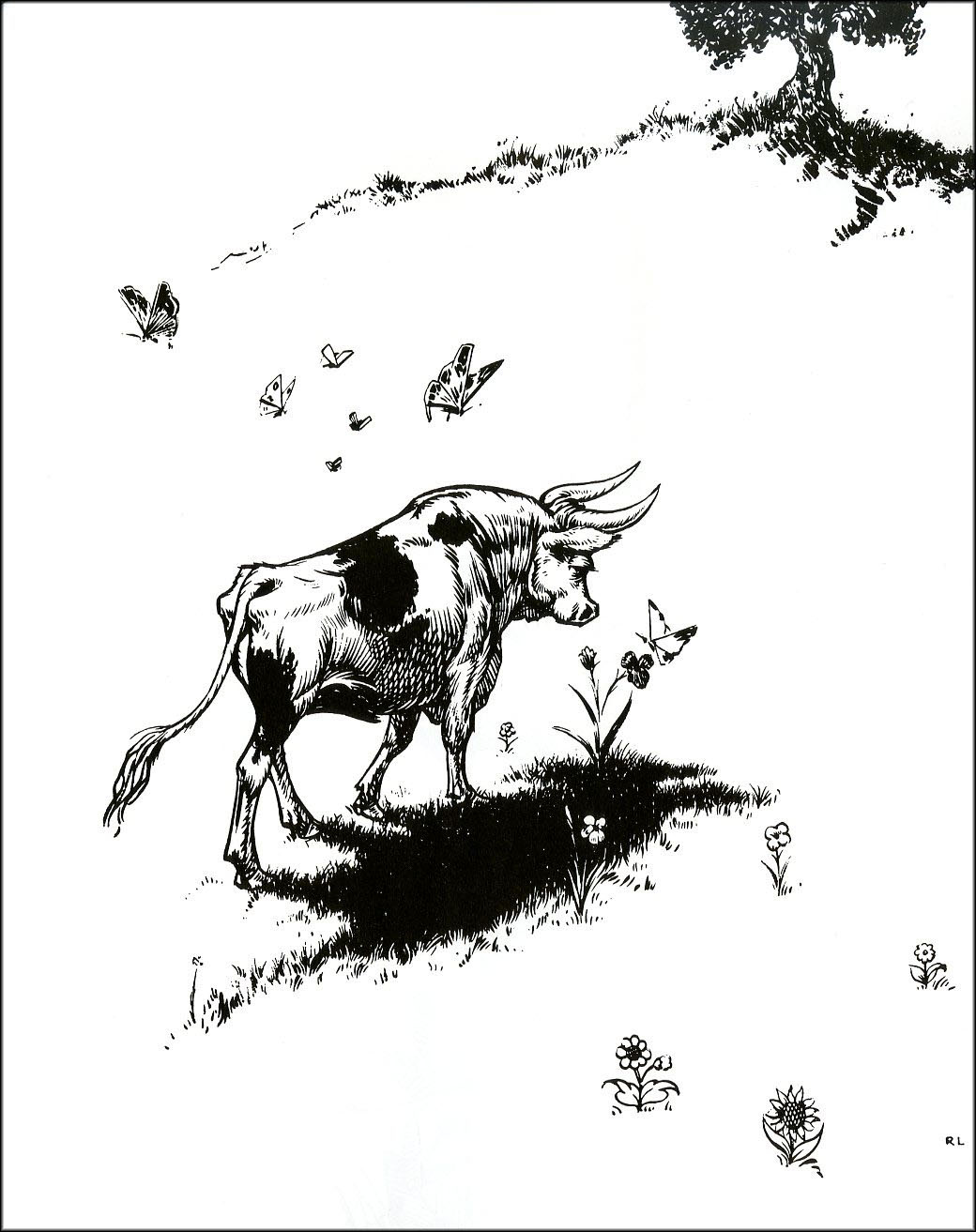
All the other bulls ran around snorting and butting, leaping and jumping so the men would think that they were very very strong and fierce and pick them.
Ferdinand knew that they wouldn’t pick him and he didn’t care. So he went out to his favorite cork tree to sit down.
Also recommended: Wee Gillis by Munro Leaf, illustrated by Robert Lawson
Originally posted July 18, 2011.
Michele and Storycraft, every Wednesday at the Hills Branch

Join Michele every Wednesday at 10:30 a.m. at the Hills Branch for for stories, songs and fun! This program is recommended for children ages 2-5 with their grownups.
Tuesday, July 17, 2012
Monday, July 9, 2012
Friday, July 6, 2012
Stars and Stripes Forever!

Thursday, July 5, 2012
Lego Club!

Lego Club begins next Tuesday, July 10th! Kids ages 8 and up are invited to design and build their own creations using our Legos. Sign up for each session one week in advance through the Children's Calendar at http://www.wellesleyfreelibrary.org/ or call the Children's Department at 781-235-1610 ext 1108. This group is limited to 12 kids each week. Sponsored by the Friends of the Wellesley Free Libraries.
More bins...

Two more bins have been added to our picture book collection! One stop shopping for people interested in picture books on a specific topic; counting and train bins are now available.

Around the World in 80 Books (give or take a few...) Middle School titles that span the globe...where will you go?
Children's librarian Rebecca Kinney, who is also a middle school librarian at Newton Country Day School of the Sacred Heart during the academic year, created this amazing clickable globe that gives lists of middle-school-appropriate books set in different regions around the world. Be an armchair traveller this summer and explore a few titles!
http://www.newtoncountryday.org/RelId/630595/ISvars/default/Around_the_World_in_80_Books.htm

http://www.newtoncountryday.org/RelId/630595/ISvars/default/Around_the_World_in_80_Books.htm

Monday, July 2, 2012
Moomins and the wonderful work of Tove Jansson

Tove Jansson is revered around the world as one of the foremost children's authors of the twentieth century for her illustrated chapter books regarding the magical worlds of her creation, the Moomins. The Moomins saw life in many forms but debuted to its biggest audience ever on the pages of the world's largest newspaper, the London Evening News, in 1954. The strip was syndicated in newspapers around the world with millions of readers in forty countries.
The Moomins are a tight-knit family-hippo-shaped creatures with easygoing and adventurous outlooks. Jansson's art is pared down and precise, yet able to compose beautiful portraits of ambling creatures in fields of flowers or on rock-strewn beaches that recall Jansson's Nordic roots. The comic strip reached out to adults with its gentle and droll sense of humor. Whimsical but with biting undertones, Jansson's observations of everyday life, including guests who overstay their welcome, modern art, movie stars, and high society, easily caught the attention of an international audience and still resonate today.
For more on Tove Jansson and her work, go to:
http://www.moomin.com/eng/
http://www.moomintrove.com/index.htm
Paddington!

Michael Bond recalls in his own words how Paddington first came into being:
"I bought a small toy bear on Christmas Eve 1956. I saw it left on a shelf in a London store and felt sorry for it. I took it home as a present for my wife Brenda and named it Paddington as we were living near Paddington Station at the time. I wrote some stories about the bear, more for fun than with the idea of having them published. After ten days I found that I had a book on my hands. It wasn’t written specifically for children, but I think I put into it the kind things I liked reading about when I was young."
Michael Bond sent the book to his agent, Harvey Unna, who liked it and after sending to to several publishers it was eventually accepted by William Collins & Sons (now Harper Collins). The publishers commissioned an illustrator, Peggy Fortnum, and the very first Paddington book "A Bear Called Paddington" was published on 13th October 1958.
In 1965, after writing several Paddington titles Michael Bond retired from his job as a cameraman with the BBC, a job he held for many years, in order to write full time.
Of Paddington himself Michael Bond says:
"The great advantage of having a bear as a central character is that he can combine the innocence of a child with the sophistication of an adult. Paddington is not the sort of bear that would ever go to the moon - he has his paws too firmly on the ground for that. He gets involved in everyday situations. He has a strong sense of right and wrong and doesn't take kindly to the red tape bureaucracy of the sillier rules and regulations with which we humans surround ourselves. As a bear he gets away with things. Paddington is humanised, but he couldn't possibly be 'human'. It just wouldn't work."
The Paddington books have sold more than thirty-five million copies worldwide and have been translated into over forty languages.
Michael Bond continues:
"I am constantly surprised by all the translations because I thought that Paddington was essentially an English character. Obviously Paddington-type situations happen all over the world."
"I bought a small toy bear on Christmas Eve 1956. I saw it left on a shelf in a London store and felt sorry for it. I took it home as a present for my wife Brenda and named it Paddington as we were living near Paddington Station at the time. I wrote some stories about the bear, more for fun than with the idea of having them published. After ten days I found that I had a book on my hands. It wasn’t written specifically for children, but I think I put into it the kind things I liked reading about when I was young."
How Paddington first came into being
Michael Bond sent the book to his agent, Harvey Unna, who liked it and after sending to to several publishers it was eventually accepted by William Collins & Sons (now Harper Collins). The publishers commissioned an illustrator, Peggy Fortnum, and the very first Paddington book "A Bear Called Paddington" was published on 13th October 1958.
What happened next
In 1965, after writing several Paddington titles Michael Bond retired from his job as a cameraman with the BBC, a job he held for many years, in order to write full time.
Of Paddington himself Michael Bond says:
"The great advantage of having a bear as a central character is that he can combine the innocence of a child with the sophistication of an adult. Paddington is not the sort of bear that would ever go to the moon - he has his paws too firmly on the ground for that. He gets involved in everyday situations. He has a strong sense of right and wrong and doesn't take kindly to the red tape bureaucracy of the sillier rules and regulations with which we humans surround ourselves. As a bear he gets away with things. Paddington is humanised, but he couldn't possibly be 'human'. It just wouldn't work."
The Paddington books have sold more than thirty-five million copies worldwide and have been translated into over forty languages.
Michael Bond continues:
"I am constantly surprised by all the translations because I thought that Paddington was essentially an English character. Obviously Paddington-type situations happen all over the world."

The Paddington Books
The very first Paddington book was "A Bear Called Paddington" which was published in the UK by William Collins (now Harper Collins) in 1958. Illustrated with pen and ink drawings by Peggy Fortnum, this title is a novel in eight chapters and is still available today. There are eleven further titles in this series, the most recent of which was published in 2008, exactly fifty years after the very first book. These are the stories which tell most of Paddington's adventures.
With the first year of publication, they are as follows:
By clicking on the titles you can read a brief synopsis of each of the stories.
In 1972 the first picture books for younger readers were published. These were illustrated by Fred Banbery and there were six titles in the series.
In the 1980's another series of picture books were introduced. These books were a smaller format and were illustrated by David McKee.
The most recent Paddington picture books to be published are those which have been beautifully illustrated by the American artist, R.W. Alley and, in addition to recent brand new titles, he has also re-illustrated many of the earlier picture books.
With the inclusion of a large number of acitivity and board books for very young children, in total there have been over 150 different Paddington books published since 1958. However,from a collector's point of view, the most valuable are the first editions of the original novels.
With the first year of publication, they are as follows:
- A Bear Called Paddington
- More About Paddington 1959
- Paddington Helps Out 1960
- Paddington Abroad 1961
- Paddington at Large 1962
- Paddington Marches On 1964
- Paddington at Work 1966
- Paddington Goes to Town 1968
- Paddington Takes the Air 1970
- Paddington on Top 1974
- Paddington Takes the Test 1979
- Paddington: Here and Now 2008
- Paddington Races Ahead 2012
By clicking on the titles you can read a brief synopsis of each of the stories.
In 1972 the first picture books for younger readers were published. These were illustrated by Fred Banbery and there were six titles in the series.
In the 1980's another series of picture books were introduced. These books were a smaller format and were illustrated by David McKee.
The most recent Paddington picture books to be published are those which have been beautifully illustrated by the American artist, R.W. Alley and, in addition to recent brand new titles, he has also re-illustrated many of the earlier picture books.
With the inclusion of a large number of acitivity and board books for very young children, in total there have been over 150 different Paddington books published since 1958. However,from a collector's point of view, the most valuable are the first editions of the original novels.
For much more about Paddington, go to http://www.paddingtonbear.com/home.html
Thursday, June 28, 2012
Decorating book bags at the WFL!


Kids unleashed their creativity at our two-day book decorating workshop, part of our summer reading kickoff week at the Wellesley Free Library!
More book bins are arriving!

The alphabet book bin arrived today, joining dinosaurs, princesses, firefighters, pirates and trucks for quick and easy ways to find picture books on specific topics!
Tuesday, June 26, 2012
A Great Summer Classic from 1952


Robert McCloskey interviewed by Anita Silvey
http://archive.hbook.com/history/radio/mccloskey.asp
From Anita Silvey's Book-A-Day Almanac:
“I scream, you scream, we all scream, for ice cream,” goes the old ditty, and today marks National Chocolate Ice Cream Day. What a wonderful idea—two of the world’s most popular foods, chocolate and ice cream, celebrated together. For me, chocolate ice cream in June conjures up wonderful summer days, the ocean, sea gulls wailing, walks on the beach, clamming. In short, it brings to mind the plot of Robert McCloskey’s One Morning in Maine.
In the 1940s McCloskey married Margaret Durand, the daughter of storyteller and author Ruth Sawyer. In 1946 after their daughter Sally was born, the three of them moved from New York to an island on the Maine coast. Picture books of the modern era often lack a sense of place, but Robert McCloskey’s classic picture books of the late forties and early fifties are firmly grounded in details of the Maine coast and life in a small Maine community. These titles include two Caldecott Honor books, Blueberries for Sal (1948) and One Morning in Maine (1952), and the Caldecott Medal winner Time of Wonder, which made McCloskey the first artist to win the Medal twice.
In an interview, McCloskey once said that he always had one foot planted firmly midair—and the other on a banana peel. But rather than creating an absurdist or fantasy world as such a comment suggests, his Maine books are firmly grounded in reality. One Morning in Maine is the most personal picture book I know that has remained in print for almost sixty years. In it, Sal discovers that she has a loose tooth. She’s afraid she won’t be able to sail to Buck’s Harbor with her father as planned. But her mother talks to her and then sends Sal to help her father dig clams. Sal tells everyone she meets about her loose tooth—the fish hawk, the loon, and the seal. As she helps her father, she prattles on about her tooth, only to discover that it is missing and has fallen in the mud. They find a gull feather for her to make a wish on, and Robert, Sal, and baby sister Jane head out on the boat while their mother makes clam chowder. At the local store, Sal’s wish comes true—she gets a chocolate ice cream cone. And in the final line of the book the three head off for “CLAM CHOWDER FOR LUNCH!”
McCloskey renders this slice-of-life picture book so realistically that you can almost hear the gulls crying! Readers have been invited into a day of the McCloskey family’s life, one that is both special and very normal.
One Morning in Maine shows the details and beauty of the Maine coast, but it was also obviously created by a proud father. For many years now, the real Sal and Jane have been the guardians of their father’s work, protecting it from commercialization and exploit. I’ve always been grateful to them for their defense of these books, because the pressures on those who hold estate rights can be quite intense. Readers grew to love the children Sal and Jane in books. Now they have grown up to become women whom we can still admire. Let’s all raise an ice cream cone today—one chocolate and one vanilla—in their honor!

Counting Our Way To Maine by Maggie Smith
From School Library Journal
PreSchool-Grade 1-More than a counting book, this lively summer vacation story will be a welcome addition to anyone's bookshelf. The colorful, amusing pictures invite readers along on the trip and encourage them to look closely as they count up to 20 (fireflies). The journey itself is a realistic one for a family of five and two dogs-"We had to stop for the bathroom six times!" The warm-hearted family even buys ice cream for their pets. Smith's watercolor and pastels with ink marvelously blend details and humor. The parents and children build 11 sand castles, pick 15 boxes of blueberries, find 17 mushrooms, and get 18 mosquito bites. Dad bakes 16 pies while each dog eats 1 (behind his back), the mischievous baby is covered with blueberries, and the little girl adds marshmallows to her pie. An engaging summer offering, and a great concept book to boot.
Janet M. Bair, Trumbull Library, CT
Copyright 1995 Reed Business Information, Inc.
Janet M. Bair, Trumbull Library, CT
Copyright 1995 Reed Business Information, Inc.

A book for summer...

"Frazee (Roller Coaster) salutes grandparents and slyly notes children's diversions in this breezy tale of “the best week ever.” After Eamon enrolls in nature camp, he spends nights with his grandparents, Bill and Pam, at their beach cottage. Eamon's friend James joins the sleepover, and although the text describes James as “very sad” when his mother drives away, a cartoon shows him exuberantly waving “Bye!” Humorous contradictions arise between the hand-lettered account (“Bill handed them each a pair of binoculars and a list of birds to look for. On the way home, the boys reported their findings”) and voice-bubble exchanges between the boys (Eamon, training the lenses on James: “His freckles are huge.” James: “Yeah, and his tongue is gross”). Bill tries to interest the boys in a museum exhibit on penguins; the inseparable friends (“To save time, Bill began calling them Jamon”) show no enthusiasm yet energetically build “penguins” from mussel shells. Frazee's narrative resembles a tongue-in-cheek travel journal, with plenty of enticing pencil and gouache illustrations of the characters knocking about the shoreline. Like The Hello Goodbye Window, Frazee's story celebrates casual extended-family affection, with a knowing wink at the friends' dismissal of their elders' best-laid plans." (starred review)(Publishers Weekly 20080301)
A Real Nice Clambake

--Claudia Cooper, Ft. Stockton Independent School District, TX (c) Copyright 2010. Library Journals LLC, a wholly owned subsidiary of Media Source, Inc. No redistribution permitted.
(c) Copyright 2010. Library Journals LLC, a wholly owned subsidiary of Media Source, Inc.
Happy Fourth!

School Library Journal Review:
PreS-K-- A small town celebrates America's birthday . and the family featured in Thanksgiving at Our House (1991) and A Valentine for You (1991, both Clarion) joins in the fun. Everything is red, white, and blue in a subdued, pastel sort of way. Snippets of patriotic songs, childhood rhymes , and chants are boxed and set off from the illustrations. Fried chicken, potato salad, and fireworks are all part of the pleasant, rural festivities. A perfectly nice rendering of the external aspects of our nation's holiday, but urban children and recent immigrants may need some explanations of some of the colloquialisms. --Anna Biagioni Hart, Martha Washington Library, Alexandria, VA (c) Copyright 2010. Library Journals LLC, a wholly owned subsidiary of Media Source, Inc. No redistribution permitted.
(c) Copyright 2010. Library Journals LLC, a wholly owned subsidiary of Media Source, Inc.
We will be closing at 5 p.m. on July 3rd and closed on July 4th; have a great holiday!
Tuesday, June 19, 2012
Spring 2012 Great Websites for Kids!
The Great Websites for Kids Committee of the Association for Library Service to Children (ALSC) has announced its picks for Spring 2012!
A full listing of the Great Websites for Kids can be found here: http://gws.ala.org/

Be sure to check out the highlighted internet sites on the Children's page of the WFL website, both in the "Fun and Games" and "Look it up!" sections.
Spring 2012 Great Web Sites
ABCya!
www.abcya.com
Make learning fun with a variety of educational computer games for kids. Learn
new skills and improve old ones in areas such as math, language arts, and
typing.
All About Birds
www.allaboutbirds.org
Learn all about birds in this website created by the Cornell Lab of
Orinthology. Bird names, species, location and history are all featured. Also
included are bird songs and videos.
CIA for Kids-Games
www.cia.gov/kids-pages/games/
Find out what the CIA is all about, play games, and solve puzzles. Resources
for various audiences including parents and teachers.
Common Sense Media
www.commonsensemedia.org
Common Sense Media helps parents make decisions about media and technology for
their families. Information and advice is provided in a variety of formats
including reviews, videos, and even lesson plans.
Generation on Youth Advisory Council
www.generationon.org
Whether you are looking for something to do after school or to fulfill a
service requirement, you'll find inspiration to change the world around you
here. This interactive website has a volunteer position search, blogs full of
personal stories, and offers project tips from young people like you!
Judy Schachner
www.skippyjonjones.com
Fun, festive, and full of fantastic resources, this author webpage includes
interactive stories, games, print-outs, and educator resources.
PBS Kids Raising Readers Kids Island
www.pbskids.org/island
Helps children develop and practice basic reading skills through online games
and activities with their parent, teacher or caregiver.
Poptropica
www.poptropica.com
Created by Jeff Kinney of "Wimpy Kid" fame, this virtual world invites young
gamers to create a character and to undertake age-appropriate quests on over a
dozen "islands" based on themes from history, nature, and human culture.
Seymour Simon
www.seymoursimon.com
Called by the New York Times "the dean of [children's science] writers," Simon
offers information about himself and his books (over 250 and counting!) on his
official site, along with study guides, science news and videos, a science
dictionary and more.
The New York Times Learning Network
www.nytimes.com/learning
The New York Times Learning Network provides teaching and learning materials
and ideas based on NYT content. It includes lesson plans and resources for
teachers as well as quizzes and activities for students 13 and older.
We Give Books
www.wegivebooks.org
We Give Books enables children to read a book online and after doing so, a
physical book will be donated to a child in need through literacy programs
around the world. Created by the Penguin Group and the Pearson Foundation, it
combines the promotion of literacy, both to the child reading online and the
giving of books, and the concept of giving.
A full listing of the Great Websites for Kids can be found here: http://gws.ala.org/

Be sure to check out the highlighted internet sites on the Children's page of the WFL website, both in the "Fun and Games" and "Look it up!" sections.
Spring 2012 Great Web Sites
ABCya!
www.abcya.com
Make learning fun with a variety of educational computer games for kids. Learn
new skills and improve old ones in areas such as math, language arts, and
typing.
All About Birds
www.allaboutbirds.org
Learn all about birds in this website created by the Cornell Lab of
Orinthology. Bird names, species, location and history are all featured. Also
included are bird songs and videos.
CIA for Kids-Games
www.cia.gov/kids-pages/games/
Find out what the CIA is all about, play games, and solve puzzles. Resources
for various audiences including parents and teachers.
Common Sense Media
www.commonsensemedia.org
Common Sense Media helps parents make decisions about media and technology for
their families. Information and advice is provided in a variety of formats
including reviews, videos, and even lesson plans.
Generation on Youth Advisory Council
www.generationon.org
Whether you are looking for something to do after school or to fulfill a
service requirement, you'll find inspiration to change the world around you
here. This interactive website has a volunteer position search, blogs full of
personal stories, and offers project tips from young people like you!
Judy Schachner
www.skippyjonjones.com
Fun, festive, and full of fantastic resources, this author webpage includes
interactive stories, games, print-outs, and educator resources.
PBS Kids Raising Readers Kids Island
www.pbskids.org/island
Helps children develop and practice basic reading skills through online games
and activities with their parent, teacher or caregiver.
Poptropica
www.poptropica.com
Created by Jeff Kinney of "Wimpy Kid" fame, this virtual world invites young
gamers to create a character and to undertake age-appropriate quests on over a
dozen "islands" based on themes from history, nature, and human culture.
Seymour Simon
www.seymoursimon.com
Called by the New York Times "the dean of [children's science] writers," Simon
offers information about himself and his books (over 250 and counting!) on his
official site, along with study guides, science news and videos, a science
dictionary and more.
The New York Times Learning Network
www.nytimes.com/learning
The New York Times Learning Network provides teaching and learning materials
and ideas based on NYT content. It includes lesson plans and resources for
teachers as well as quizzes and activities for students 13 and older.
We Give Books
www.wegivebooks.org
We Give Books enables children to read a book online and after doing so, a
physical book will be donated to a child in need through literacy programs
around the world. Created by the Penguin Group and the Pearson Foundation, it
combines the promotion of literacy, both to the child reading online and the
giving of books, and the concept of giving.
Wednesday, June 13, 2012


Subscribe to:
Posts (Atom)